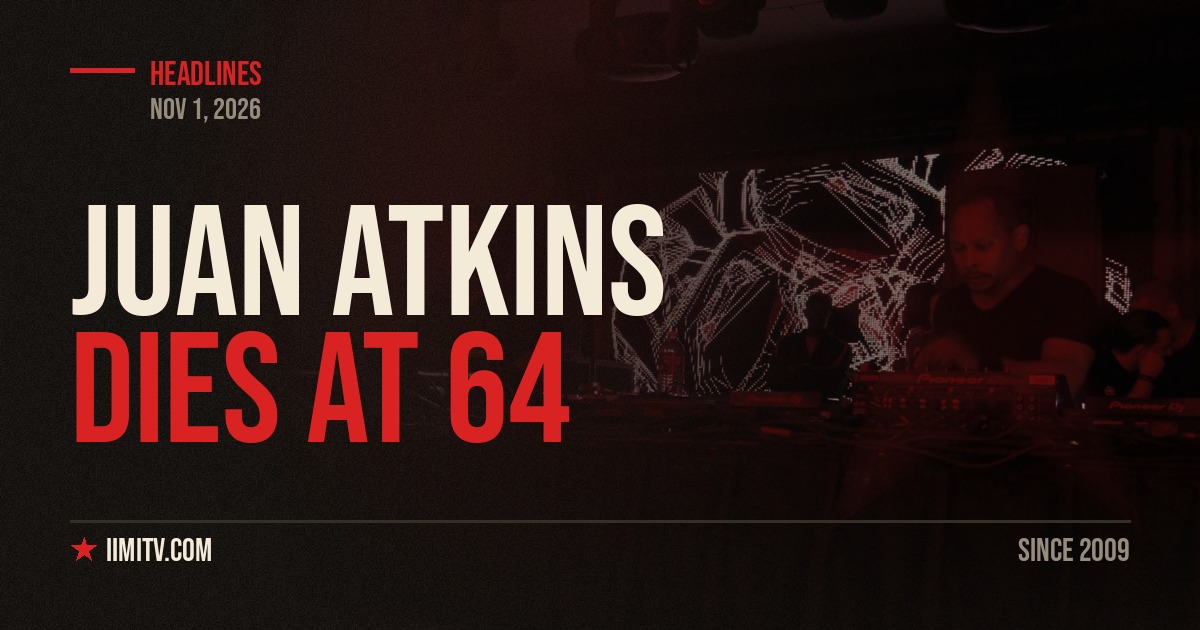
Juan Atkins, the Detroit producer widely credited as a co-founder of techno music, has died at 64. Pitchfork reported the Juan Atkins death on Sunday, November 1, and memorial posts from across the Detroit techno community followed within the hour, led by a portrait dated 1962 to 2026 shared by Greensmith Artists.
Atkins, who recorded as Model 500 and Infiniti and co-founded Cybotron, built the template that became Detroit techno alongside his school friends Derrick May and Kevin Saunderson, the trio known as the Belleville Three. Mixmag has described him as “the original pioneer of Detroit techno,” and AllMusic critic John Bush conferred the title “godfather of techno” on Atkins, calling his discography “perhaps the most influential body of work in the field of techno.” No cause of death was given in the first reports on Sunday, and no statement from his family had been published at the time of writing.
Juan Atkins Death Marked By Detroit Tributes
The first memorials came from inside his own city and scene. Greensmith Artists posted a black and white portrait of Atkins on Sunday afternoon, his name set over the years 1962 to 2026, and the image was quickly shared across Facebook and Instagram. Detroit DJ Stacey Pullen, a verified account and one of the second wave producers Atkins inspired, posted a three-image tribute on Instagram: a young Atkins in the studio, a later portrait, and a closing slide reading “Juan Atkins, 1962 to 2026.” Tributes in several languages followed from club culture pages and DJs outside the United States, a measure of how far the sound he started in Belleville, Michigan, travelled.
Atkins had been open about serious health problems earlier in his life. In 2015 he cancelled a run of European shows and detailed his condition in a public post, explaining that he had been travelling with dialysis equipment since experiencing kidney failure, after a treatment failure left him needing emergency medical assistance on a trip to Germany. He recovered and returned to touring, and he was still performing and being honoured in public within the last two years.
The Belleville Three And The Birth Of Cybotron
Atkins was born in Detroit in 1962, the son of a concert promoter, and music was in the house early: he played bass in funk and garage bands as a teenager, then bought his first synthesizer, a Korg MS-10, at 15 after hearing synthesizers on Parliament records. After his parents split he moved to Belleville, where at junior high school he met Derrick May and Kevin Saunderson. The three friends were listening to the same radio: Detroit DJ Charles Johnson, the Electrifying Mojo, whose shows mixed Kraftwerk, Gary Numan, Prince and the B-52’s with heavy funk, a collision that became the Belleville Three’s blueprint. Atkins also took ideas and vocabulary from futurist Alvin Toffler, whose books supplied the words techno and Cybotron, the second coined from cyborg and cyclotron.
In 1980 Atkins formed Cybotron with Richard “3070” Davis, releasing early singles including “Alleys of Your Mind” and “Cosmic Cars” on his own Deep Space Records. The duo’s debut album, Enter, arrived on Fantasy Records in 1983 and carried two records that still anchor the genre’s origin story: “Clear,” a heavily sampled electro track that has been referenced by generations of producers, and “Techno City,” released in 1984. Craft Recordings, reissuing Enter for its 40th anniversary, described the album as featuring “such iconic tracks as ‘Cosmic Cars,’ ‘Techno City,’ and the heavily sampled ‘Clear’,” and called it “a cornerstone of the Detroit Techno sound, as well as a pivotal influence on electronic music.”
Model 500, Metroplex And No UFOs
Atkins and Davis split in 1985, and Atkins answered by founding his own label, Metroplex Records, and a solo alias, Model 500. The label’s first release, catalogue number M-001, was “No UFOs,” a record regularly described as the first track sonically recognisable as techno as the world now knows it: machine drums, a funk synth bassline and a vocal about keeping your head held high. It was an underground hit in Detroit, broke bigger in Chicago, and was followed by Model 500 records including “Night Drive (Thru-Babylon),” “Off To Battle” and “The Chase.” Metroplex, alongside May’s Transmat and Saunderson’s KMS, became one of the foundational Detroit labels, and Atkins used it to nurture the next names through, among them Eddie “Flashin'” Fowlkes and Anthony “Shake” Shakir. The trio also ran the Deep Space Soundworks collective and the Music Institute, a downtown Detroit club that gave the new sound a room of its own.

In 1988 the music got its name in public. British journalist and label figure Neil Rushton compiled Techno! The New Dance Sound of Detroit for Virgin’s 10 Records, working with Atkins, May and Saunderson, and the compilation carried the Belleville sound to Europe under the word Atkins had been using for years. What followed was a second life for the music overseas, in Berlin, London and beyond, while its makers were still young men from a Detroit suburb.
Four Decades On, The Work Never Stopped
Atkins kept building after the founding records. Under the Infiniti alias he released the album Skynet on Berlin’s Tresor label in 1998. As Model 500 he released the albums Deep Space in 1995, Mind and Body in 1999 and Digital Solutions in 2015. With German producer Moritz von Oswald he formed Borderland, releasing the albums Borderland in 2013 and Transport in 2016, a Detroit to Berlin bridge built by two of the men who defined their cities’ sounds. The Belleville Three also performed together as a unit, launching officially at Coachella in 2017 and playing Detroit’s Masonic Temple that May. Cybotron returned to the stage at London’s Barbican in April 2019, and in 2023 Atkins revived the project on record with the EP Maintain The Golden Ratio, the first Cybotron release in 28 years.
The honours kept pace with the work. In May 2025, during Movement Festival weekend in Detroit, Atkins was celebrated at an industry event marking the 40th anniversary of Metroplex Records, where Roland presented him with a commemorative plaque. “I had a wonderful time joining my community for a celebration of techno music and the strides we’ve made over the past 40 years,” Atkins said at the time. “When I founded Metroplex Records, techno music was just beginning. Along with my mentor Rik Davis and later with my friends Kevin Saunderson, Derrick May, and myself, referred to sometimes as the ‘Belleville Three,’ we were just experimenting with different beats and gear.” He was scheduled to be honoured again next week, on November 7, at the National Museum of African American Music in Nashville, at a day of programming built around his career, including the donation of his artifacts to the museum’s collection.
That is the scale of the loss Detroit is absorbing tonight. Techno is now a global industry of festivals, arenas and headline DJs, and its founding document was written by three school friends in Belleville with a Korg synthesizer, a drum machine and a futurist paperback. Juan Atkins was the first of them to record, the one who named the music, founded its first label and cut its defining early records as Cybotron and Model 500. Derrick May and Kevin Saunderson survive him as the Belleville Three’s remaining members. iimiTV sends its condolences to Atkins’ family, to May and Saunderson, and to everyone in Detroit and far beyond it dancing to the music he started.