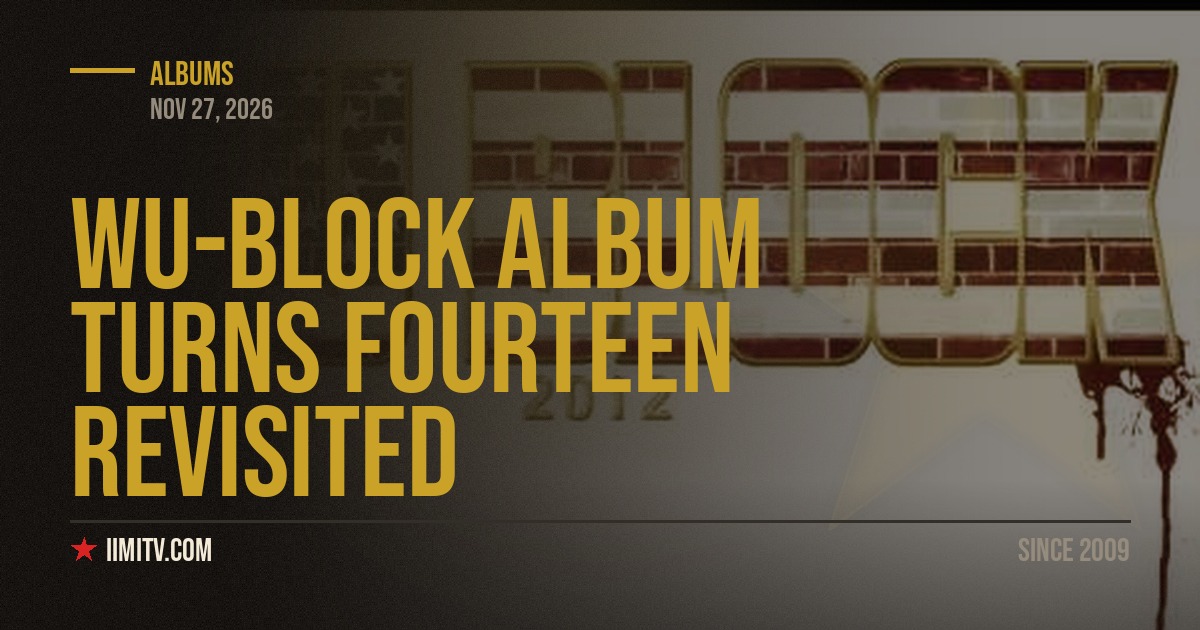
Ghostface Killah and Sheek Louch released Wu-Block on Tuesday, November 27, 2012, through eOne Music, and the collaborative album turns fourteen today, Friday, November 27, 2026. The idea was in the title: Wu-Tang Clan’s most prolific solo voice joining forces with Sheek Louch of The Lox and D-Block, two New York camps whose members had circled each other for years, finally sharing one tracklist, one cover and one billing.
The record runs 52 minutes and 37 seconds in its standard edition, and its guest list is the concept made concrete. Raekwon, Jadakiss, Cappadonna, Method Man, Styles P, Masta Killa, GZA and Inspectah Deck all appear, and Erykah Badu sings on Drivin Round, the one track Ghostface himself sits out. Hear that record here, in the official MNRK audio:
Join The iimiTV Letter
Enter your email and we will send you a confirmation link. Click it and your first edition lands on Friday.

Wu-Block Tracklist: Two Camps, One Lineup
The standard tracklist, as published when Exclaim! carried the album’s details in October 2012, runs: Crack Spot Stories with Raekwon and Jadakiss, Pour Tha Martini with Cappadonna, Pull Tha Cars Out with Method Man, Guns For Life with Styles P, Comin For Ya Head with Styles P and Raekwon, Cocaine Central with Styles P, Take Notice, Drivin Round with Masta Killa, GZA and Erykah Badu, Different Times Zones with Inspectah Deck, Stick Up Kids with Jadakiss, All in Together with Styles P and Jadakiss, Do It Like Us with Raekwon, Stella with Method Man, and Been Robbed, with a deluxe edition adding Bust Shots. The first single, Union Square, had arrived earlier, on June 29, 2012.
The build was public and patient. In February 2011, Sheek Louch said he and Ghostface were already about eight songs deep into the album, and the release date moved more than once, from October to November 13 before settling on November 27. Sheek explained the premise in his own words: “Wu-Block mixes the rap style, lyrics, beats, imagery and ideology of the 9 member Wu-Tang clan with the flow, underground star power, hard hitting bars, street story telling and bass rattling sounds of D-Block.” That is the record’s whole design stated plainly, and the finished album follows it track by track, pairing the two camps in almost every combination the lineup allows.
The Chart Record And The Reviews
The commercial record is documented in the album’s chart history. Wu-Block debuted at No. 73 on the Billboard 200 with first week sales of 8,600 copies in the United States, and reached No. 15 on Top R and B and Hip-Hop Albums and No. 9 on Top Rap Albums. Those are modest numbers beside either camp’s biggest solo records, and they were never really the point: this was a crew record built for the audience that had followed both rosters since the nineteen nineties, released in the holiday week by an independent label.
Critics met it on those terms. At Metacritic, the album holds an average score of 69 out of 100 from 13 reviews, described as generally favourable, and RapReviews, in its December 2012 review, singled out Drivin Round as the album’s highlight, praising Badu’s subdued chorus and the refined verses from Masta Killa and GZA on a track Ghostface does not appear on at all. iimiTV has revisited the Wu-Tang catalogue around it, from 36 Chambers to Ghostface’s own Ironman at 30, and Wu-Block is the piece that shows what happened when that world deliberately merged with another crew’s.
Why Wu-Block Still Matters At Fourteen
Crew collaboration albums were common in 2012, but few were built this evenly. Ghostface appears on every track but one, Sheek anchors the D-Block side throughout, and the features are not decoration: Styles P appears across the middle of the record, Jadakiss closes arguments on three tracks, and the Wu-Tang rotation changes the temperature every few songs. The production stays loyal to the sample heavy, cinematic sound both camps were raised on, which is why the album has aged as a period piece in the best sense, a document of New York rap’s elder generation working together instead of competing.
Start with Drivin Round for the album at its smoothest, Crack Spot Stories for its four man opening statement, and All in Together for the fullest meeting of the two lineups. Then hear the whole record as what it was announced as in 2011 and delivered as on November 27, 2012: not a Wu-Tang album with guests, and not a Lox record in disguise, but a genuine shared billing, fourteen years old today and still the only one of its kind in either catalogue.