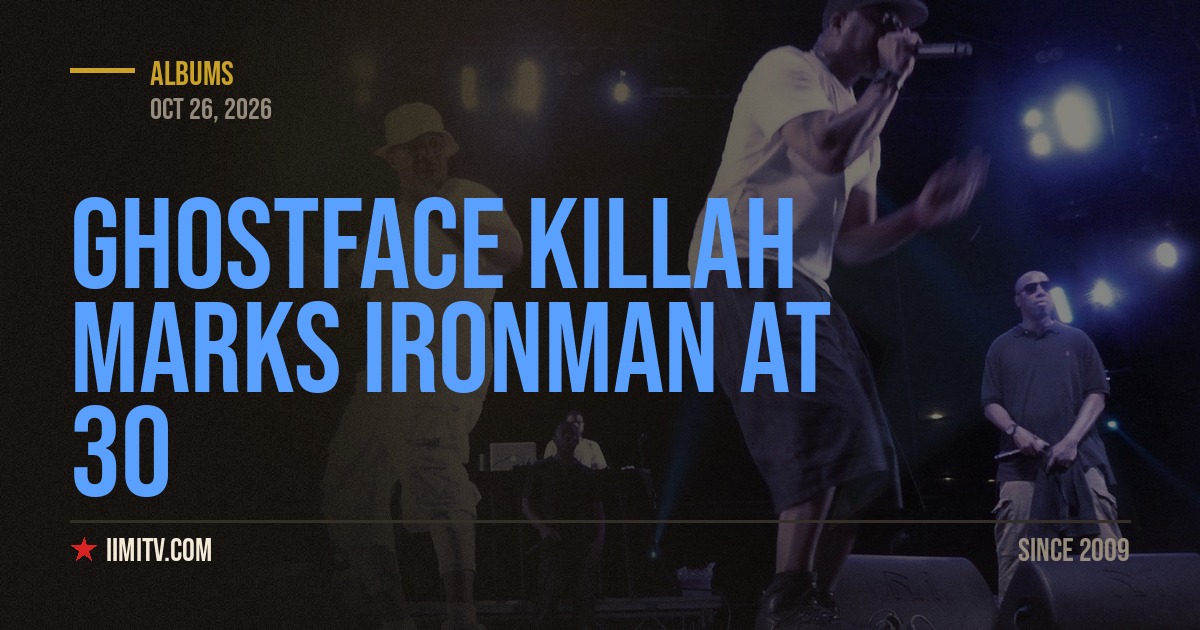
Ghostface Killah released his debut solo album Ironman on October 29, 1996, through Razor Sharp Records, Wu-Tang Records and Epic Street, and the Ghostface Killah Ironman 30th anniversary lands this week, on Thursday, October 29, 2026. Thirty years on, the album is being marked again in print, with Albumism publishing its Turns 30 tribute on October 24, 2026, and a 2026 repress listing keeping the record in current circulation.
That framing matters. Ironman is catalogue, and it is treated here as catalogue: a platinum certified debut that arrived at No. 2 on the Billboard 200, has been argued over and celebrated for three decades, and still anchors the case for Ghostface as the Wu-Tang Clan’s most consistent solo artist. He has released thirteen solo albums since, and this is where the run started.
Ghostface Killah Ironman 30th Anniversary: The Record
Ironman runs 17 tracks and 64 minutes, recorded between July 1995 and April 1996 at Mystic Studios and 36 Chambers Studios on Staten Island. RZA produced almost the whole album and served as executive producer alongside Mitchell Diggs, Oli Grant and Ghostface himself, credited as D. Coles. The one exception is Fish, produced by True Master. Albumism notes that Ironman was the last Wu-Tang solo album produced almost entirely by RZA, and the final one in the Clan’s initial trademark style, which makes it a closing chapter as much as a debut.
It is also a solo album in name only. Only four tracks feature Ghostface as the sole rapper. Raekwon appears on 12 of the 17 tracks, including a full solo turn on The Faster Blade, and Cappadonna appears on five. Both men share the album cover and billing with Ghostface, a structure that made Ironman the bridge between Raekwon’s Only Built 4 Cuban Linx, where Ghostface had co-piloted eleven of eighteen tracks a year earlier, and the solo era that followed.

Soul Records Under the Slang
The sound is built on blaxploitation and soul samples, with dialogue drawn from The Education of Sonny Carson and The Usual Suspects. Iron Maiden samples Al Green’s Gotta Find a New World, and 260 loops Al Green’s You Ought to Be with Me. Camay is built on Teddy Pendergrass’s Can’t We Try, Daytona 500 on Bob James’s Nautilus, and Fish on Otis Redding’s Change Is Gonna Come. The Delfonics sing on After the Smoke Is Clear, and Force MDs close the record’s guest list on The Soul Controller, a track later removed from pressings after 2001 over uncleared samples, a collector detail that still shapes which version of Ironman a buyer finds today.
Ghostface has traced that soul foundation to his mother’s record collection, the Chi-Lites and Stylistics playing at home long before RZA’s colour coded boxes of beat tapes entered his life. Telling Ambrosia For Heads about choosing beats after a studio flood, he remembered the system plainly:
He had crazy boxes; the yellow box was the best box
The singles tell the same story in sequence. All That I Got Is You led the album on September 22, 1996, Daytona 500 followed on October 7, and Motherless Child arrived with the album on October 29. Camay and Winter Warz became standouts with soundtrack lives of their own, Winter Warz in Don’t Be a Menace and Motherless Child in Sunset Park.
All That I Got Is You, the Emotional Centre
The lead single was not a chart play. All That I Got Is You is a dedication to Ghostface’s mother, built on the Jackson 5’s Maybe Tomorrow, sung on by Mary J. Blige, who Ghostface personally requested for the song, and closed by Popa Wu. Its verses describe fifteen people in a three bedroom apartment, sharing one spoon and picking roaches out of the cereal box. The video, directed by Terry Heller and Chuck Ozeas, featured Tekitha singing Blige’s parts because Blige was unavailable for the shoot. About.com later ranked the song No. 87 on its Top 100 Rap Songs list.
Ghostface later explained what he was carrying into those sessions. Speaking to Billboard for the album’s 25th anniversary in October 2021, he described a diabetes diagnosis and lost weight, a best friend sentenced to 25 years in prison as the album’s creation began, and a depression that he said lasted through Wu-Tang Forever up to Supreme Clientele. Two tracks on Ironman, The Faster Blade and Assassination Day, do not feature him at all, because, in his words, he could not write to those records. Looking back at the whole period in that same Billboard conversation, he said:
You have to go through hell to come out right, and I never knew God would have me in this position right here where people can understand and love you for what you created.
Thirty Years On, the Numbers Hold
Ironman debuted at No. 2 on the Billboard 200 and No. 1 on Billboard’s Top R&B/Hip-Hop Albums chart, selling 156,000 copies in its first week. Canadian listeners sent it into the top five of the Canadian Albums Chart. It was certified gold in January 1997 and platinum by the RIAA on February 9, 2004, and it remains the best selling album of Ghostface’s career. Supreme Clientele followed in 2000 and built the critical reputation further, but the commercial and creative template was set here, in 1996, by a debut that was really a trio record, powered by soul samples and one of the most distinctive voices rap has produced.
Anniversaries are easy to overstate, and this one does not need help. A No. 2 debut, a platinum plaque, a lead single addressed to his mother that still appears on all time lists, and a 2026 repress thirty years later add up to a simple verdict. Ironman was the moment Ghostface Killah stopped being Wu-Tang’s secret weapon and became a solo artist of the first rank, and at 30 it still sounds like exactly that.