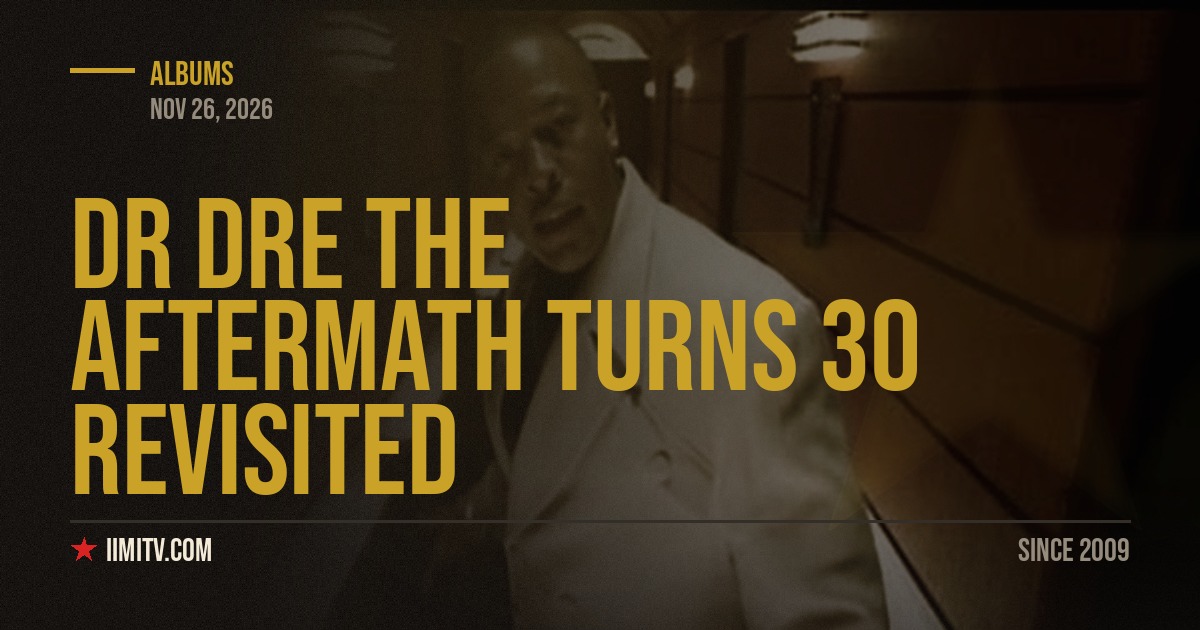
Dr. Dre released Dr. Dre Presents: The Aftermath on Tuesday, November 26, 1996, through Aftermath Entertainment and Interscope Records, and the compilation turns 30 today, Thursday, November 26, 2026. It was the first release on Aftermath, the label Dre founded after leaving Death Row Records in March 1996, and it was never built as a solo album: across 16 tracks and 71 minutes, Dre mostly hands the microphone to the roster he had just signed and produces from behind the board.
The one track with Dre himself as the main vocalist is Been There, Done That, his solo single and the record’s clearest statement of intent, a deliberate step away from the gangsta framing he had helped build. He performed it live on Saturday Night Live on October 26, 1996, a month before the album landed. Watch the official video here:
Join The iimiTV Letter
Enter your email and we will send you a confirmation link. Click it and your first edition lands on Friday.

Dr. Dre Presents The Aftermath Tracklist: A Roster Introduction
The tracklist reads as a label sampler, because that is what it was. After the Aftermath intro with RC, Sharief and Sid McCoy, Group Therapy, the one off grouping of RBX, KRS-One, B-Real and Nas, carries East Coast/West Coast Killas, released as the first single on August 13, 1996, with Dre on the chorus and a Scarface cameo in its video. The song brought California and New York voices onto one record to push back against the coastal rivalry then dominating rap coverage, and it samples Quincy Jones’s Ironside theme. Blunt Time pairs RBX with Dre and Roger Troutman, Been There, Done That follows, and the back half rotates through Kim Summerson’s Choices, built on Isaac Hayes’s Look of Love, King T on Str-8 Gone and L.A.W. (Lyrical Assault Weapon), and a closing Fame that reworks David Bowie’s song of the same name with King T, RC and Jheryl Lockhart.
The production bench matters as much as the guest list. The album was largely produced by the label’s in house team, the Soul Kitchen: Dre, Bud’da, Flossy P, Stu-B-Doo and Chris “the Glove” Taylor, with Mel-Man alongside. That workshop model, a producer collective building a house sound track by track, became the working method Aftermath carried into everything that followed.
The Chart Record: No. 6, No. 3 And Platinum
The commercial record is documented in the album’s chart history. The Aftermath peaked at No. 6 on the Billboard 200 and No. 3 on Top R and B and Hip-Hop Albums in the United States, reached No. 69 on Canada’s RPM albums chart, and was certified Platinum by the RIAA for shipments over one million units in the United States. Been There, Done That reached No. 40 on Billboard’s Rhythmic Top 40. Those are strong numbers for a compilation with almost no lead vocals from its headline name, and they proved the label could sell on Dre’s production credit and curation alone.
The reviews were cooler than the sales. Entertainment Weekly graded it B+, while other major outlets were mixed, and the principals have never oversold it since. Chris “the Glove” Taylor later reasoned: “People were upset because they wanted a ‘Dr. Dre’ album. They weren’t looking for a compilation album.” Dre himself was blunt about the period: “It was just okay. That was a hit and miss,” adding that musically he was off balance and trying to find his footing again after the label split.
Why The Aftermath Still Matters At 30
Judged as a rap album, The Aftermath is a transitional record. Judged as a founding document, it is the first brick of the most consequential label run of the next decade: Aftermath signed Eminem in 1998, released Dre’s own 2001 in 1999 and built from there into the 50 Cent era. None of that exists without the infrastructure this compilation announced in November 1996: the Soul Kitchen production team, the Interscope partnership and Dre repositioned as an executive producer whose name could carry a roster.
Start with Been There, Done That for Dre’s own voice, East Coast/West Coast Killas for the Group Therapy lineup that could only have happened on this record, and Fame for the strangest and most confident closer on the album. Then hear the whole 71 minutes as what it actually is: not the sequel to The Chronic that 1996 wanted, but the sound of a producer starting over in public, thirty years ago today, and getting the foundation right even when the songs were still catching up.