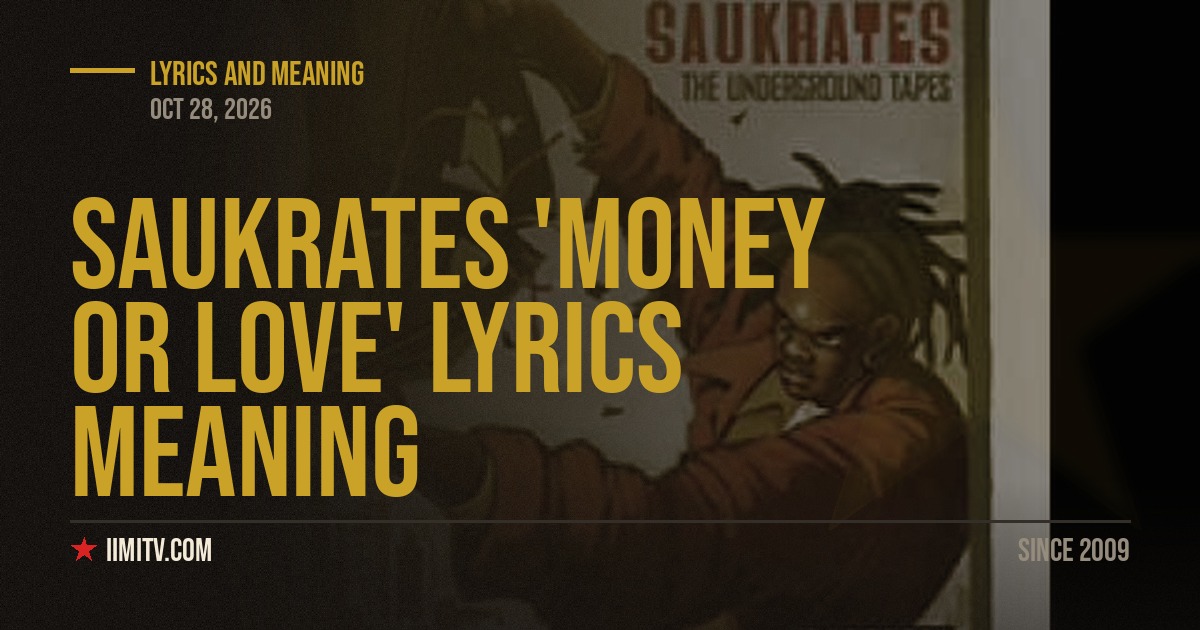
Saukrates released “Money or Love” in 1999 as the only single from his debut studio album The Underground Tapes, released June 22, 1999 in the United States through Serious Entertainment and Capitol Hill Music, with an expanded Canadian re-release later that summer. The Saukrates Money or Love lyrics meaning starts with the title itself, which is not a metaphor. It is a choice, posed as a question the whole song has to answer.
This is a catalogue single, explained as catalogue. It was nominated for a Juno Award in 2000, its video won Best Independent Video at the 2000 MuchMusic Video Awards, and a quarter century later Saukrates was still explaining, in his own anniversary commentary, why this was the record where everything about his method came together.

Saukrates Money Or Love Lyrics Meaning Is A Choice
Most rap singles of 1999 treated money as the answer. This one treats it as one of two answers, and spends the song weighing them. The title frames a working artist’s real dilemma at the end of the underground era: chase the cheque and shape the music to sell, or protect the music and accept what that costs. Saukrates, who produced the record himself under his Big Sox credit, writes from inside that dilemma rather than above it. He was a Toronto independent artist with American attention building, guest spots multiplying and no major machine yet, and the lyric carries that exact pressure.
The writing works because the choice is never settled cheaply. Verse by verse, the song keeps returning to the same fork with higher stakes, and the hook, sung by Saukrates himself, is what turns the question into a melody people carried. That sung hook mattered in 1999 more than it reads now. In his commentary for the 25th anniversary edition, released August 23, 2024, Saukrates remembered building the record this way:
“It was probably the first time publicly, I was noticed for singing my own hooks, and being able to sing my own hooks, which was something that no MC had done at that time other than maybe two or three.”
He also remembered the guitar lick and drum sequence giving him goosebumps in the studio, the feeling that he had impressed himself, and he credited the song with catching the American industry’s attention and helping bridge him toward his later deal with Redman and Def Jam. The meaning, in other words, is documented by the writer: this is a song about what the music is for, made by an artist deciding in real time.
A Debut Album Full Of Witnesses
The album around the single explains why the question carried weight. The Underground Tapes runs 44 minutes and 50 seconds in its original form, recorded between 1996 and 1999, and its guest list reads like a roll call called to testify that Toronto’s underground was real: Xzibit on “Keep It Movin’,” Pharoahe Monch on “Innovations,” Common on “Play Dis (99 Remix),” Choclair on “Body Language,” Heltah Skeltah on “Ultimate Rush,” and Masta Ace and O.C. on “Rollin’.” Three of those songs are remixes of earlier underground records, which is the album’s method in miniature: take the tapes that built the name and present them properly.
AllMusic heard where the distinction lay:
“It’s lyrically where Saukrates distinguishes himself, as his flow and domineering habitation on the mike is utterly hypnotic.”
Against that company, “Money or Love” is the album’s third track and its only single, the one song asked to carry the whole argument to radio and video. It did. The Juno nomination in 2000 put a self-produced Toronto underground single in the national conversation, and the MuchMusic award for its video the same year confirmed the record travelled visually as well as sonically. For Canadian hip hop, still fighting for infrastructure in 1999, those were not decorations. They were proof of concept.
Why The Question Still Gets Searched
Listeners keep looking this song up because the dilemma never dated. Every independent artist since, in Toronto and everywhere else, has had to answer some version of money or love, usually in private, usually more than once. Saukrates put the question in a hook, sang it himself, and left the tension in the song instead of resolving it into a slogan. That honesty is also why the record anchored the anniversary edition in 2024, when the album returned to streaming in its expanded Canadian form with his track by track commentary attached.
Play it inside the album, third track in, after “Can’t Touch Us” has set the tempo. Released in 1999 on The Underground Tapes, “Money or Love” is Saukrates at the fork, asking the genre’s oldest question in a Toronto accent, and making the asking itself sound this good.