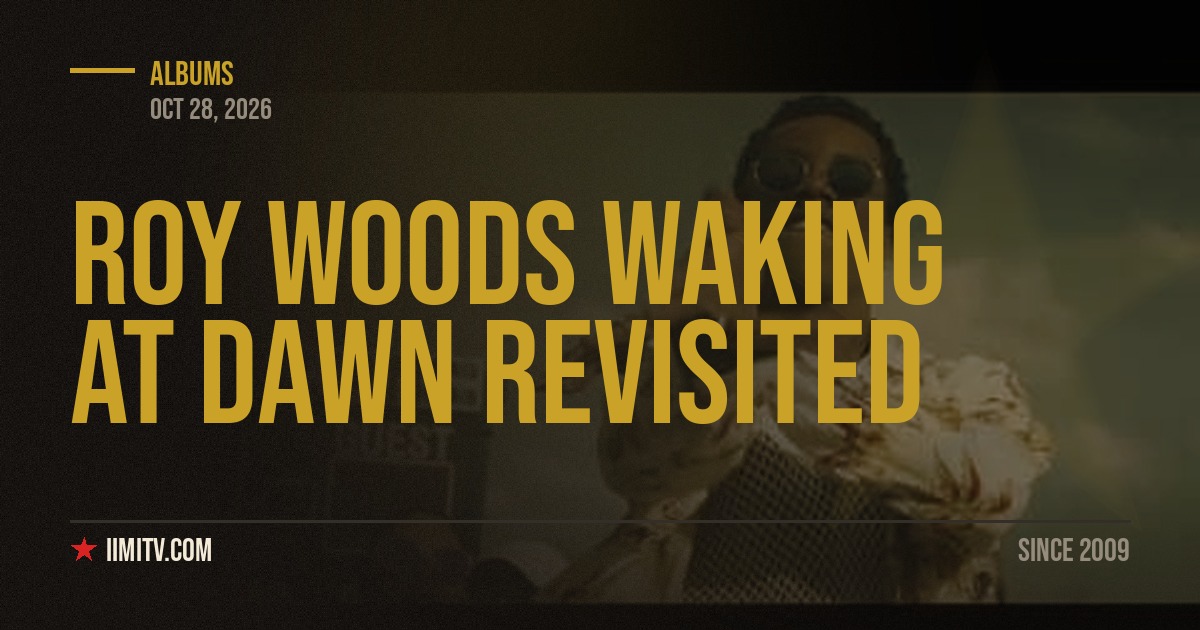
Roy Woods released his debut studio album Waking at Dawn on July 1, 2016 through OVO Sound and Warner Bros. Records. The Brampton singer, born Denzel Spencer, had announced the title on March 11, 2016, revealed the release date and cover art on June 29, and delivered a 10-track, 35-minute record two days later.
This is a catalogue album, framed as catalogue. Nothing here is new, and the Roy Woods Waking at Dawn story does not need new framing. It is the first full-length statement from an artist who arrived through an EP, a Drake feature and a voice that sounded like nobody else on his label, and it still holds the clearest map of what he could do.

Roy Woods Waking At Dawn Starts With Two Singles
Both singles arrived on the same day, June 4, 2016, and they pointed in opposite directions on purpose. “Gwan Big Up Urself,” the official video above, directed in bright summer colours, is the playful half: a dancehall-tinged record built for daylight, carried by Woods’s Guyanese heritage and a hook that tells the listener to celebrate themselves. “How I Feel” is the other half, a pledge to put himself first, with the skittering production and the high, strained vocal that had become his signature on the Exis EP in 2015.
That EP is the necessary background. Exis, released in the summer of 2015, carried “Drama” featuring Drake, the record that introduced Woods to most listeners, along with “Get You Good,” “Unleashed” and “Innocence.” Waking at Dawn had to answer a specific question: could the voice that made one EP moment travel across a full album, without Drake in the room? The tracklist answers by keeping the guest list empty. All 10 songs are Woods alone.
The Ten Tracks, And Where The Album Turns
The sequencing moves from confidence to confession. “Sonic Boom” opens wide and melodic, “You Love It” follows brighter and more rhythmic, and “Gwan Big Up Urself” lands third as the album’s sunlight. Then the record darkens in stages: “How I Feel,” “Down Girl” and “Switch,” produced in part by Murda Beatz, where Woods takes stock of who changed around him as the success arrived. “Got Me” slows the middle down, “Why” stretches to four minutes and 22 seconds of questioning, and “Menace,” the longest track at four minutes and 53 seconds, is the record’s most guarded hour.
The closing track, “She Knows About Me,” brings the album back to the relationship writing that filled the EP. Across the 10 tracks the production stays inside a small Toronto circle: FrancisGotHeat, Prezident Jeff and Sunny Diamonds handle much of the record, with Murda Beatz, DZL, Akeel Henry, L.A. Chase and Krs. contributing. Sunny Diamonds also engineered and mixed the whole album, which is part of why a record that keeps changing tempo still sounds like one place.
Reviewers heard the promise and the unfinished edges in the same listen. Exclaim! praised the album’s:
“flashes of maturity”
while faulting Woods for holding back emotionally on some songs. HotNewHipHop scored the album 74 out of 100, and NOW gave it three stars. Read together, the reviews agree on the shape of the record: a debut with a singular voice, still deciding how much of himself to put on the page.
The Chart Footprint Of A Quiet Debut
The numbers match that reading. Waking at Dawn peaked at No. 30 on the Canadian Albums chart, No. 127 on the Billboard 200 and No. 11 on the US Top R&B/Hip-Hop Albums chart. Those are not blockbuster figures, and the album was never built as one. It was built as a foundation, and the career that followed stands on it: the Nocturnal EP arrived later in 2016, and his second studio album, Say Less, followed in 2017 with a wider guest list and a more settled version of the same voice.
For Canadian R&B, the album’s place is specific. Toronto’s mid-2010s wave is usually told through its biggest names, but the wave had depth because records like this one filled in the sound between the hits: alternative R&B sung by a Brampton artist of Guyanese descent, moving between dancehall, confession and melody without treating any of them as a costume. Among Toronto rappers and singers of that era, Woods was the one most willing to sound vulnerable at full volume.
How To Hear It Now
Play Waking at Dawn in order, and listen for the turn at “Switch,” where the celebration gives way to the accounting. Then play “Gwan Big Up Urself” again and hear how much lighter it sounds with the whole record behind it. Released July 1, 2016, Waking at Dawn is Roy Woods before the polish, and that is exactly its value: ten tracks, no guests, one voice learning what it could carry.