Drake released “Started from the Bottom” on February 1, 2013, and this Drake Started from the Bottom revisited piece keeps the date honest: this is a catalogue record, thirteen years old, not a new drop. It arrived as the first single from his third studio album Nothing Was the Same, and it became the phrase his whole career is still summarised by.
The song was planned for February 10, Grammy night, and moved up instead. Drake premiered it on February 1 through his October’s Very Own blog, choosing to release it without prior interviews, and it reached digital stores on February 6. A lead single launched on a blog post, with no rollout interview, was a statement of method as much as of biography.
Drake Started From The Bottom Began As A Studio Phrase
The title started as an instruction. The record emerged from a studio session with Future, who kept asking the personnel to start the instrumental from the bottom, meaning play it again from the top. Drake heard the phrase as a song title, and built the record around it. What sounds like a slogan was, at first, a working note in a room.
The production matched the economy of the idea. “Started from the Bottom” was produced by Mike Zombie, with additional production by Noah “40” Shebib, and it is built on drums, piano and a sample of “Ambessence Piano & Drones 1,” an ambient piece by Bruno Sanfilippo. The finished record runs two minutes and fifty three seconds. There is almost nothing in it that is not load bearing, which is exactly why the hook could travel as far as it did.
A Short Record Making A Long Argument
The song is Drake answering a story other people were telling about him. Behind the hook sits a specific complaint: that his beginnings were being rewritten by people who did not know them. He laid the concept out when the song arrived:
“I did not buy my way into this spot and it was the furthest thing from easy to achieve. I am proud of every part of my past and I’m excited for this song to find a place in your life as well.”
That is the record’s real subject, authorship of his own biography. The verses move through the working years, the family support and the team that was present before the money, and the refrain turns that account into a team anthem rather than a solo boast. The crew is in the grammar of the song from the first chorus onward, which is a large part of why sports teams, graduates and small businesses all adopted the line as their own.
The Video Put Toronto In The Frame
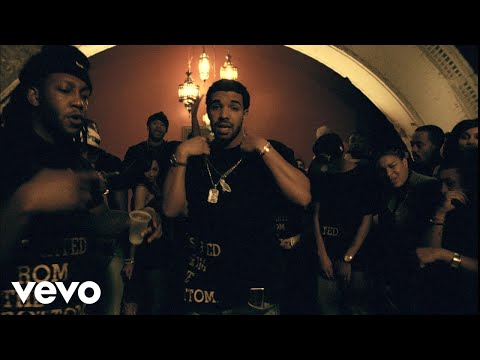
The video, directed by Director X and released on February 10, 2013, on Grammy night, is the visual half of the argument. Drake works a retail shift at a Shoppers Drug Mart, stands in the back of a white Bentley convertible in a blizzard, flies into his native Toronto and closes the night at a villa in the Dominican Republic with his friends. His mother Sandi appears, and so do producers Boi-1da and Noah “40” Shebib.
Read it as a before and after in one cut. The drugstore shift and the snow are the bottom, shot plainly and played for recognition rather than pity. The plane home to Toronto is the point of the whole exercise: the success in the frame is measured by the return, not the departure. Few videos of the era did as much city branding work for Toronto simply by treating it as the destination.
The Numbers And The Afterlife
The commercial record is settled. The song peaked at No. 6 on the Billboard Hot 100, becoming his eleventh top 10 hit on that chart, sold more than two million digital copies in the United States by January 2014, and now stands at eight times Platinum in the US and Platinum in Canada. It won Track of the Year at the BET Hip Hop Awards and was nominated for Best Rap Performance and Best Rap Song at the Grammy Awards.
The critics placed it just as high. Complex named it the second best song of 2013, with the magazine calling it “wistful, atmospheric, as catchy as a nursery rhyme,” and Rolling Stone ranked it ninth on its list of the 100 best songs of that year, while XXL placed it among the year’s top five hip hop songs. A wave of remixes followed within weeks, Wiz Khalifa first among them, and the phrase outlasted all of them, passing into everyday language, the NBA 2K14 soundtrack and film trailers.
Thirteen years on, the record holds up because it was never only a hit. It is the mission statement of Nothing Was the Same, the album that followed it in September 2013, stated in under three minutes. For the full era in sequence, read our Drake Take Care essential tracks revisited piece alongside it, and play this one first: the bottom, as he framed it, is where the catalogue’s modern chapter starts.