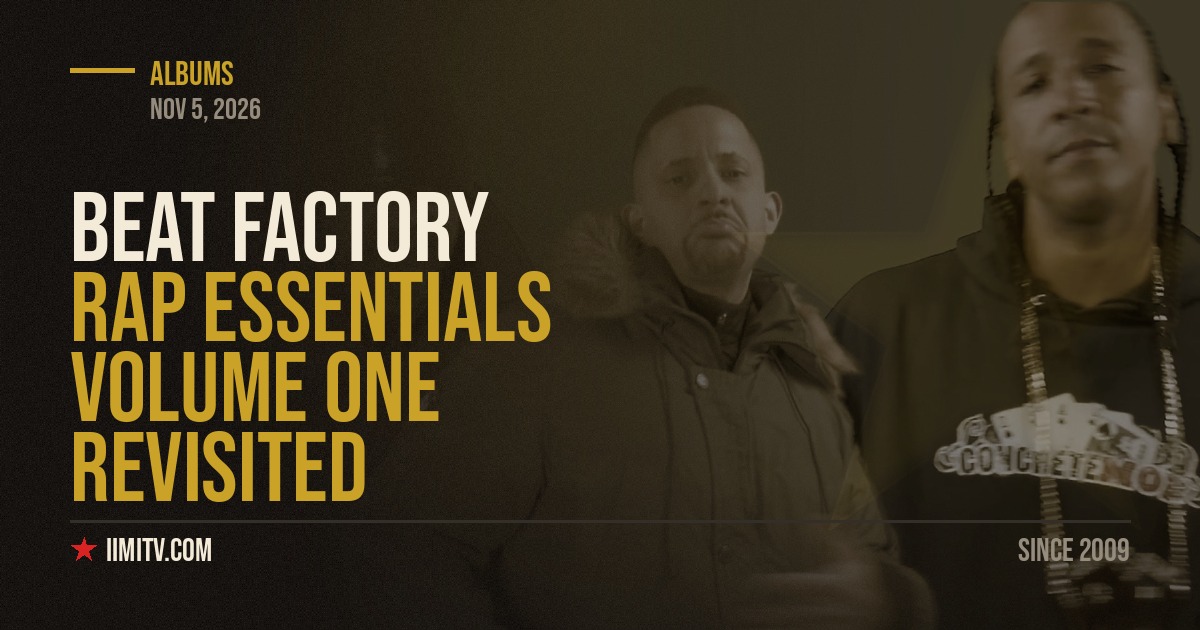
Toronto label Beat Factory released Rap Essentials Volume One on November 5, 1996, thirty years ago today. The compilation gathered twelve tracks from the generation then building Canadian hip hop in this city, and a Rap Essentials Volume One revisit starts with a simple fact: few single records did more to put Toronto rappers in front of a national audience.
The album was the brainchild of Ivan Berry, whose Beat Factory had already shepherded Michie Mee and the Dream Warriors, and it arrived through Beat Factory Music with distribution from EMI Music Canada. CBC Music later summed up its place in the culture in a headline that has stuck to the record ever since, calling it the album that put 1990s Canadian hip hop on the map. Thirty years on, that billing holds up track by track.
Join The iimiTV Letter
Enter your email and we will send you a confirmation link. Click it and your first edition lands on Friday.
Rap Essentials Volume One, Track By Track
The full sequence runs twelve songs in 46 minutes and 40 seconds, produced by a small circle of Toronto boardsmen: DJ Kemo, Scam, Down ta Erf, Kardinal Offishall, DRK, DJX, Swiff, DJ Luv, Kandu, Day and Kwajo Cinqo. The compilation’s track listing opens with the Rascalz and “Fitnredi,” moves through Concrete Mob’s “Boiling Point” and Down ta Erf’s “Learn to Earn,” and closes with Ghetto Concept’s “U.L.”
The middle of the record is where its reputation lives. Kardinal Offishall’s “Naughty Dread,” his debut single, built on a sample of Bob Marley’s “Natty Dread,” sits fourth. Wio-K’s “Sunlight,” Dan-e-o’s “Dear Hip Hop,” Scales Empire’s “Bright Lights, Big City” and Choclair’s “Twenty One Years” follow in a run that captures the city in several registers at once: reggae-blended, reflective, hungry. Black-I, Red Life and Citizen Kane round out a lineup that reads today like a roll call of the scene’s foundation.
Three Juno Nominations From One Compilation
The industry noticed quickly. Three songs from the album, “Naughty Dread” by Kardinal Offishall, “Fitnredi” by Rascalz and “Bright Lights, Big City” by Scales Empire, were nominated for Best Rap Recording at the 1997 Juno Awards, a remarkable haul for one independent Toronto compilation. The Canadian Encyclopedia’s Kardinal Offishall entry underlines what “Naughty Dread” meant on its own: as his first single, included on this landmark compilation, it earned the Juno nomination that started his run toward becoming a central figure in bringing Canadian hip hop to the mainstream.
Television carried the record the rest of the way. Music videos for “Dear Hip Hop,” “Bright Lights, Big City” and “Sunlight” went into rotation on MuchMusic, which meant a compilation cut in Toronto studios was suddenly playing in living rooms across the country. For artists working in a scene the major labels had largely ignored, that rotation was the distribution that mattered.
Dear Hip Hop Launched Dan-e-o
No track on the album travelled further than “Dear Hip Hop.” Dan-e-o was eighteen when he recorded it. URBNET’s history of the song recounts how, on December 5, 1995, he rode a TTC bus from Scarborough with four Monolith crewmates to Frankenstein’s Ill Laboratories studio in Woodbridge, where producer Scam had two beats ready: “Dear Hip Hop” and a second song, “Constipated.” Dan-e-o and Scam chose “Dear Hip Hop” for the compilation, a decision to lead with growth rather than the harder record, and on the album’s release it quickly became a favourite and then a Canadian hip hop classic.
Dan-e-o remembered what the MuchMusic rotation felt like from inside it, in a Musicworks history of RapCity: “When RapCity debuted the video for ‘Dear Hip Hop,’ it was played at the end of the show after a Shaquille O’Neal video. I just remember thinking, ‘You got this NBA superstar and little old me back-to-back on RapCity.’” Two decades later he returned to the record with the album Dear Hip Hop: 20 Years Later, whose “Rap Essentials” track reunites him with compilation alumni Mathematik and Deuce Deuce of Concrete Mob, in the video below.

Why Rap Essentials Still Matters In Toronto
Context is the compilation’s real legacy. It landed after the first wave of Canadian rap success, the era of Maestro Fresh Wes, Michie Mee and the Dream Warriors, at a moment when Canadian major labels had cooled on the genre and an independent vinyl scene was flourishing in Toronto anyway. Berry’s compilation curated the cream of that scene onto one nationally distributed record, giving artists like Kardinal, Choclair and the Rascalz a wider audience and giving the next generation a document to measure itself against.
That is why the thirtieth anniversary is more than a round number. Every Toronto rapper who has since carried this city onto bigger stages works in a business that Rap Essentials Volume One helped prove could exist. Twelve tracks, three Juno nominations, one career launched out of Scarborough, and a compilation that still sounds like a city introducing itself: on November 5, 1996, Toronto hip hop put its founding document on the record, and it has not needed to introduce itself since.