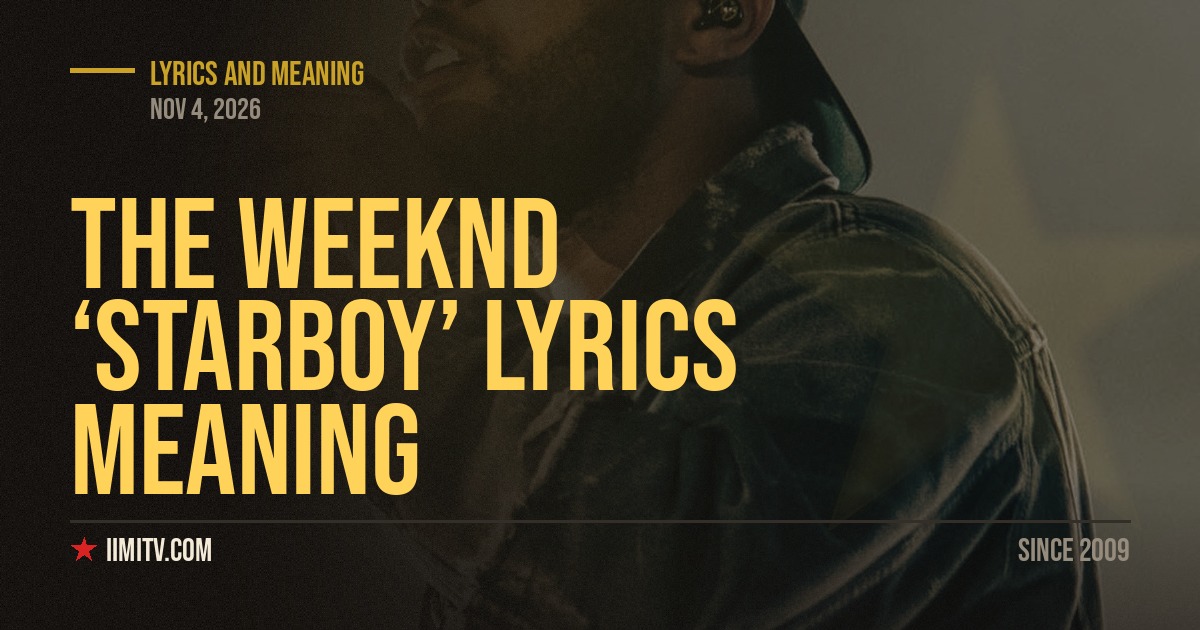
The Weeknd released ‘Starboy’, featuring Daft Punk, on September 22, 2016, as the lead single and title track from his third studio album, Starboy. The song introduces a new persona for the Toronto singer, and the weeknd starboy lyrics meaning is built on that change: fame has made him richer, harder and more visible, and it has also made the person underneath harder to reach.

Join The iimiTV Letter
Enter your email and we will send you a confirmation link. Click it and your first edition lands on Friday.
What the Weeknd Starboy Lyrics Meaning Comes Down To
Starboy is a word with roots in Jamaican slang, where a star bwoy is a man who is cool, important and respected among his peers. The Weeknd takes that local compliment and scales it up to global celebrity. In the chorus he points the result back at the audience and the industry that made him, repeating the line “Look what you’ve done” before naming the character they created. The boast is the surface. Underneath it, the song argues that this character is a creation, something built by success, attention and expectation, rather than a simple portrait of Abel Tesfaye himself.
That reading matches how The Weeknd described the record at the time. Speaking to Billboard about the album, he placed its attitude in the rap music he grew up on in Toronto:
“The vibe on Starboy comes from that hip-hop culture of braggadocio, from Wu-Tang and 50 Cent, the kind of music I listened to as a kid. Bragging just sounds good, man.”
Braggadocio explains the tone, but it does not explain the whole song. The verses move quickly between confidence and complaint. He counts money, dismisses rivals and lists the rewards of a No. 1 career, then undercuts the flex with images of an empty house and a life arranged around objects. That swing is the point. The Starboy character can afford anything in the room, and the room still feels vacant. Longtime listeners will hear the same tension that runs through his earlier work, including the catalogue iimiTV has broken down in the Blinding Lights lyrics meaning and the Timeless lyrics meaning: success arrives, and the loneliness travels with it.
The Cars, the House and the Cost Underneath
Much of the writing works through specific, expensive detail. The McLaren P1, the Lamborghini Aventador SV Roadster and the Bentley Mulsanne are not named by accident. Each car is a rank in a hierarchy, proof that the singer from Scarborough who once released free mixtapes can now buy the rarest version of anything. The short fragment about the P1 being cleaner than church shoes pairs luxury with a religious image, a pattern the song returns to when faith, speed and money start to stand in for one another. Getting close to something spiritual, in this world, happens on a dashboard readout rather than in a church.
The house imagery cuts the other way. A home so empty it needs a centrepiece is a joke about interior design and a plain statement about absence at the same time. The centrepiece can be bought. The people and the ease that would make the house feel lived in cannot. That is why the song never settles into a pure victory lap. Every display of wealth carries a reminder that the wealth is on display because the Starboy persona requires it. The performance of being unbothered is part of the job, and the song lets listeners hear how tiring that performance can be.
The writing credits show how deliberately that balance was built. Tesfaye wrote the song with Daft Punk members Thomas Bangalter and Guy-Manuel de Homem-Christo, alongside Martin “Doc” McKinney, Henry “Cirkut” Walter and Jason “DaHeala” Quenneville. Daft Punk produced the track, with co-production from The Weeknd, McKinney and Cirkut. The electronic pulse keeps the song cold and controlled, so the singer can sound detached even while the lyrics describe excess at full volume.
Killing the Old Weeknd in the Video
The Grant Singer directed video, released on September 28, 2016, makes the meaning visual. The new, short-haired Weeknd suffocates his former self, the figure with the famous old hairstyle, then walks through his own mansion smashing framed platinum records with a glowing neon cross. It is a reinvention staged as a crime scene. The old persona is not retired quietly. He has to be destroyed, awards and all, before the Starboy character can take the house over.
Read against the lyrics, the video settles the argument about whether the song is celebration or warning. It is both, in that order. First the listener gets the cars, the confidence and the chorus built to be chanted back. Then the images show what maintaining the character costs the man inside it. The panther riding beside him in the McLaren, and the cross used as a weapon rather than a comfort, keep the same double meaning running: power and faith, both turned into props in the Starboy world.
Why Starboy Still Matters
The record backed its concept with numbers. It debuted at No. 40 on the Billboard Hot 100 on a single day of tracking, sat at No. 2 for eight non-consecutive weeks, and finally reached No. 1 on the chart dated January 7, 2017. It was The Weeknd’s third Hot 100 No. 1 and Daft Punk’s first and only No. 1 on that chart, and it also topped the chart in Canada. The Recording Industry Association of America certified it 11 times Platinum on April 5, 2022. The album followed on November 25, 2016, debuted at No. 1 on the Billboard 200, and later won Best Urban Contemporary Album at the Grammy Awards.
Its shelf on this site keeps growing for a reason. The same album produced the song covered in iimiTV’s Die For You lyrics meaning, and its themes carry forward into the records examined in the Save Your Tears lyrics meaning and the Cry for Me lyrics meaning. Heard together, those songs trace one long argument about fame in his catalogue: the money is real, the persona is real, and neither one answers the emptiness the songs keep circling.
That is the lasting the weeknd starboy lyrics meaning. It is not simply a rich man listing what he owns. It is an artist introducing the character success built for him, enjoying the sound of the brag, and quietly showing the audience the empty rooms behind it.