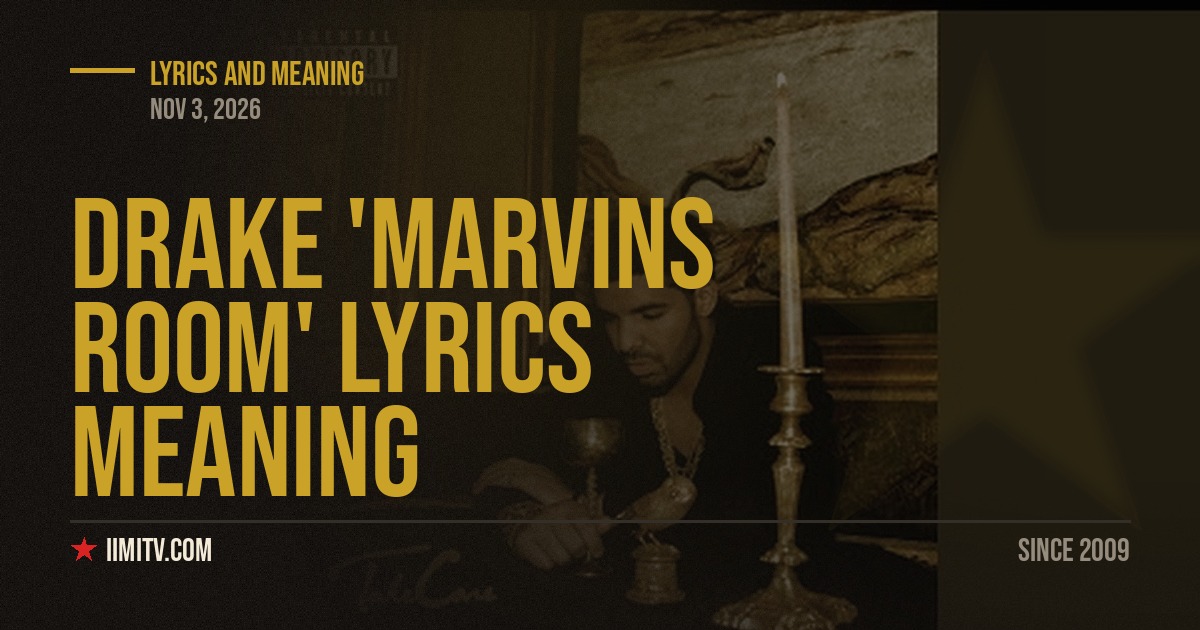
Drake posted Marvins Room to his October’s Very Own blog on June 9, 2011, months before Take Care arrived that November. The Drake Marvins Room lyrics meaning begins with that timing: a lead single with no drums to speak of, no hook built for radio, and a narrator making a phone call he already knows he should not make.
Fifteen years of confessional rap can make the song sound normal now. In June 2011 it was a risk. Drake was following a hit debut album, Thank Me Later, and the industry expectation for a lead single was scale. Instead he released five minutes and forty seven seconds of muted keyboards and low end, structured around a drunken call to an ex, and let the discomfort do the work. Understanding what the lyrics are actually saying, line by line in spirit, explains why the risk paid off and why the song outlasted bigger singles from the same album.
Join The iimiTV Letter
Enter your email and we will send you a confirmation link. Click it and your first edition lands on Friday.

Drake Marvins Room lyrics meaning starts with the phone call
The premise is a single scene. The narrator is out, drinking, surrounded by the rewards of his new fame, and he calls the woman he left behind. His argument, repeated through the song, is that she could do better than the man she is with now. On paper that sounds like a rescue. In the lyrics it plays as something sadder and more selfish: he does not promise to be better himself, he admits he has not changed, and he keeps talking because the call is the one honest thing happening in his night. The fame in the verses is not celebrated. It is the reason the call exists, the thing that emptied his life out enough to make dialing her number feel like honesty.
The woman’s side of the conversation is what gives the song its meaning. Heard in the interludes, she pushes back, names what he did and refuses the role he is offering her. That refusal is the song’s moral centre. Without it, Marvins Room would be a monologue of self pity. With it, the record becomes a portrait of a man being told the truth about himself in real time and continuing anyway, which is why listeners heard a confession rather than a serenade. Critics heard it early too; Stereophile’s 2012 writing on the song called it a veiled but nonetheless intriguing confession.
A veiled but nonetheless intriguing confession from a sensitive young man whose addictions to alcohol, sex, and fame have prevented him from developing any sort of healthy relationship.
The room in the title is a real studio
The title is not a metaphor. The song was recorded at Marvin’s Room, the Hollywood studio founded by Marvin Gaye in 1975, and named for that room. The detail matters to the meaning because Gaye’s own catalogue, the patron saint of the beautiful, self destructive love song, hangs over the record’s DNA. Drake and producer Noah 40 Shebib, who built the track with writers Jason Beck and Adrian Eccleston, were working inside the physical home of that tradition, and the song they made there is in open conversation with it: the singer who knows his own damage, recording the damage as beautifully as he can.
Shebib’s production carries half the meaning on its own. The keyboards sit underwater, the bass stays muted, and the space around the vocal feels like a room at 3 a.m. after the party has thinned out. There is no beat drop to rescue the narrator and no bridge to lift him out of the call. The arrangement refuses to let the song become the club record its setting describes, which is the production equivalent of the lyrics’ honesty.
Release, chart record and the Take Care frame
The facts around the song confirm how unusual its path was. Posted to the blog on June 9, 2011, it was serviced to urban contemporary radio on June 28 and released as a digital download on July 22, becoming the lead single from Take Care, released November 15, 2011 on Young Money, Cash Money and Republic. The album debuted at number one on the Billboard 200 with 631,000 copies in its first week. Marvins Room itself peaked at number 21 on the Billboard Hot 100 and number seven on the Hot R and B/Hip Hop Songs chart, numbers built on mood rather than tempo. Its official video, directed by Lamar Taylor and Hyghly Alleyne, translated the haze directly, all dim rooms and distance.
Why the song still defines an era
The long tail settled the argument. In 2025 the RIAA certified Marvins Room diamond in the United States, reported at the time as Drake’s 16th diamond single, a streaming era honour for a song released before streaming ruled the business. As Take Care approaches its 15th anniversary on November 15, 2026, Marvins Room remains the album’s defining confession and the template a generation of R and B leaning rappers inherited: the call you should not make, produced like a room you cannot leave, honest enough to let the other voice on the line be right.