Richard Lloyd, the co-founding guitarist of Television, died on Saturday, November 7, 2026, at his home in Chattanooga, Tennessee, at 75. Consequence, reporting Rolling Stone’s account, says Lloyd passed away on Saturday morning, and Pitchfork reported the Richard Lloyd death the same day.
The cause was cholangiocarcinoma, a serious form of bile duct cancer. Far Out, reporting a family statement shared with The New York Times, says Lloyd was diagnosed in March 2026, and that his family added: “His loving wife Sheila and his dog Willie Mays were with him at the end.” He is survived by his wife, Sheila O’Keefe Lloyd, his son, Dylan, and his brother, Eric.
Join The iimiTV Letter
Enter your email and we will send you a confirmation link. Click it and your first edition lands on Friday.
Richard Lloyd Death Follows A March Cancer Diagnosis
Lloyd revealed the diagnosis publicly in August 2026. NME’s report of the diagnosis said the cancer had left him with tumours in his liver, including one close to a major blood vessel that doctors could not safely operate on, and that he had been in intensive care seven times, with complications that included sepsis twice and problems involving his liver and kidneys.
A fundraising campaign set up by a bandmate in his Richard Lloyd Group was meant to cover medical and living costs while he could not tour and Sheila acted as his full-time caregiver. Lloyd added his own note to that appeal: “I am usually a pretty upbeat person and I am taking this in stride, but it has become very difficult on our own and financially we are strapped.” He turned 75 on October 25, less than two weeks before his death.
Born in Pittsburgh on October 25, 1951, Lloyd first picked up drums, then switched to guitar as a teenager. He was raised in New York, and the instrument became the whole of his working life for more than five decades, from the first Television rehearsals in 1973 to his last solo album, The Countdown, in 2018.
Television, CBGB And The Birth Of A Guitar Language
Lloyd formed Television in New York in 1973 with Tom Verlaine, Richard Hell and Billy Ficca. Hell left in 1975 and was replaced on bass by Fred Smith, completing the lineup that made the band’s records. Television were among the first bands to play CBGB, the Bowery club that became the centre of New York punk, and Lloyd later claimed a direct hand in getting the band booked there in 1974, opening a room that the Ramones, Blondie, Talking Heads and Patti Smith would soon make famous.
What Television did inside that room set them apart from every other band on the bill. Punk in 1974 was built on power chords and speed. Lloyd and Verlaine built theirs on interplay instead: two guitars trading lead and rhythm lines, answering and interrupting each other, with melody and counter-melody where other bands put force. Consequence’s account of his playing notes the rare use of power chords on the title track of the debut album and the template it set for angular, harmonically restless guitar work in the post-punk bands that followed.
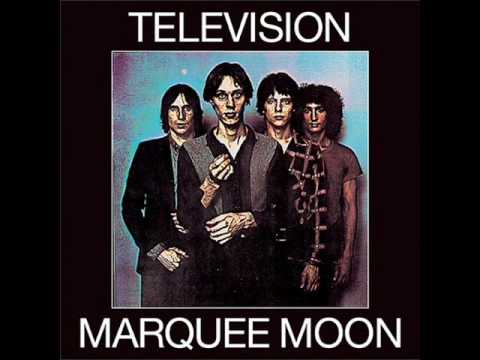
Marquee Moon Still Carries His Name
Television’s debut album, Marquee Moon, was released by Elektra Records on February 8, 1977. Its eight tracks include the ten-minute title track, and the recording places Verlaine’s and Lloyd’s guitars in separate channels, left and right, so a listener can follow each line on its own and hear exactly how the two parts lock together. That is the specific detail guitarists have studied ever since: not a soloist with a backing player, but two equal voices, rehearsed and choreographed down to who plays which solo on which song.
The album was a critical success on release and its standing has only grown. It is now treated as a foundational record for post-punk, new wave and alternative rock, and the guitar playing on it has been credited as an influence by players in R.E.M., the Pixies, Sonic Youth and U2, whose guitarist The Edge built part of his own sound on what he heard Television do. Television followed it with Adventure in 1978 and split the same year. They reunited to release a third, self-titled album in 1992, and again in the 2000s, before Lloyd left the band on good terms in 2007. Verlaine died in January 2023, and bassist Fred Smith died in February 2026, so Lloyd’s death closes the lives of three of the four men who made Marquee Moon.
A Solo Career And A Second Life As A Sideman
Lloyd’s work outside Television was substantial in its own right. His solo records began with Alchemy in 1979 and ran through Field of Fire in 1986, the live album Real Time in 1987, and on to The Countdown in 2018. Field of Fire in particular drew the critical praise that re-established him as a major talent in his own name after the first Television split.
He also became a trusted guitarist for other songwriters, most notably Matthew Sweet, whose 1991 album Girlfriend carries Lloyd’s playing at its centre and remains a landmark of power pop. That double life, band founder and hired guitarist, is part of why his influence runs wider than Television’s small catalogue, three studio albums across two decades, would suggest.
He described his own relationship to the work plainly in a 2000 interview quoted by Consequence: “I am a musician by refusing to grow up, and not wanting to undertake any of the other disciplines that might have been necessitated by having a goal. I lived in absolute terror of growing up, and I found the one thing that you could actually do and do well and it prevented you from growing up.”
Television made only three studio albums, and Lloyd’s name will always sit first beside one of them. Marquee Moon has never really left the conversation about what two guitars can do, and every band that has built a song on interlocking lines instead of a wall of chords since 1977 has been working, knowingly or not, in a space Lloyd helped open. He died at home, with his wife beside him, 49 years after that record was released.