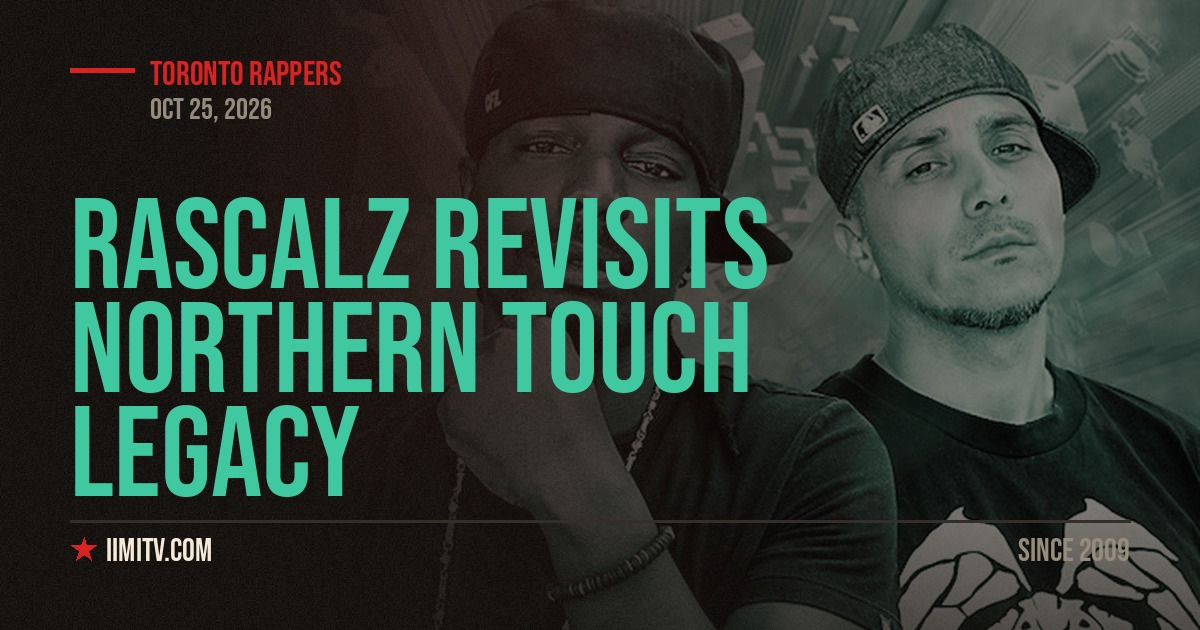
This is a deep dive, not new music news: Rascalz released Northern Touch in 1998, and the song remains the hinge that Canadian hip hop history swings on. Recorded by the Vancouver group with Toronto rappers Kardinal Offishall, Choclair, Thrust and Checkmate, it became the first Canadian hip hop hit since 1991 and forced the Juno Awards to change how rap was treated on the national stage.
To understand why one single still gets its own chapter in every history of toronto rappers and the wider Canadian scene, you have to start with how unlikely its existence was. There was no proven market, almost no radio pathway, and no guarantee that artists from opposite coasts could move as one. Northern Touch answered all three doubts at once.
A song recorded for a compilation that never happened
Northern Touch was originally recorded in 1997 for a compilation album that fell through and was never released. Rather than shelve it, Rascalz put it out as a standalone single in 1998. The lineup was the message: Rascalz, the Vancouver group built around Red1 and Misfit, sharing one record with four rising Toronto voices, Checkmate, Kardinal Offishall, Thrust and Choclair, at a moment when both scenes were still fighting for basic visibility.
The record connected immediately. It peaked at number 41 on the national RPM chart, reached the Top 10 in most major markets, and became the first Canadian hip hop song to reach the Top 100 and win widespread radio play in Canada and internationally since 1991. The video, directed by Little X and featuring Melyssa Ford, gave the song a visual identity that matched its ambition. It was quickly adopted as an anthem for Canadian hip hop’s resilience and determination, and later pressings of the group’s album Cash Crop added it to the tracklist after it had already become one of the biggest hit songs in the history of Canadian hip hop.
The Juno stance that changed the ceremony
The song cannot be separated from what happened around the group’s album. Cash Crop won Best Rap Recording at the Juno Awards of 1998, but the rap award was presented during the non televised technical ceremony rather than the main broadcast. Rascalz declined the award, saying its scheduling showed that Black music was still not being included in the ceremony in any real way:
In view of the lack of real inclusion of black music in this ceremony, this feels like a token gesture towards honoring the real impact of urban music in Canada. Urban music, reggae, R&B, and rap, that’s all black music, and it’s not represented at the Junos. We decided that until it is, we were going to take a stance.
The stance worked. The debate it sparked pushed the Junos to move the rap category into the main ceremony the following year, and at the Juno Awards of 1999, the first time the rap award was presented during the televised show, Northern Touch won it. The artists then performed the song live in Hamilton, the first time a hip hop group had ever performed on the Juno Awards stage. A protest, a policy change and a televised performance, all inside twelve months, all traceable to this camp.
Why Northern Touch still defines Toronto rappers
The song’s afterlife keeps renewing it. In 2018, for its 20th anniversary, Kardinal Offishall reworked the record into a Toronto Raptors playoff remix for Sportsnet broadcasts, rewriting his famous hook for the team’s run. Asked why the parallel worked, he pointed straight at what the original had proven:
The whole We the North movement is a straight parallel to what Northern Touch personified at that time. It’s one of the first times with hip-hop culture coming out of Canada where everyone was united from the East to West Coast.
The institutions have kept catching up since. Cash Crop was shortlisted for the Polaris Heritage Prize at the 2025 Polaris Music Prize, a formal recognition that the album belongs in the permanent Canadian canon. For the Toronto rappers working today, in a city whose artists now headline global charts as a matter of routine, Northern Touch is the documented starting point: the record that proved a Canadian rap song could chart, could fill a Juno stage, and could unite two coasts behind one hook. Revisited today, it sounds less like a museum piece than like a foundation stone that everything since has been built on.