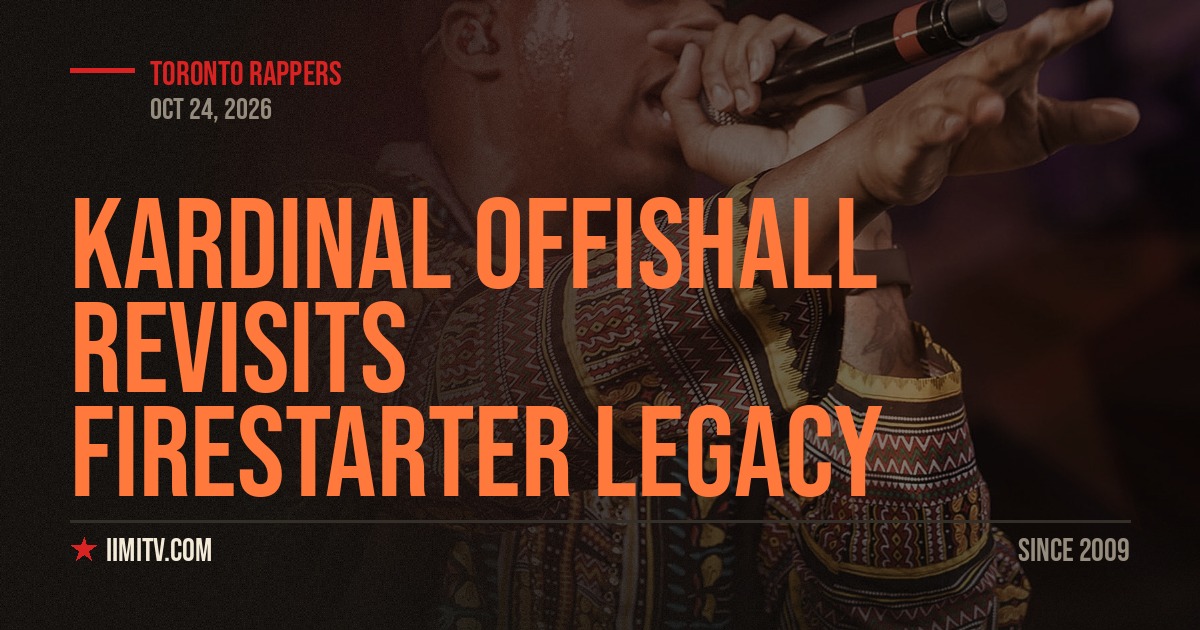
Kardinal Offishall released Kardinal Offishall Firestarter Vol 2, titled Firestarter Vol. 2: Everyday, Sometimes, on September 25, 2026, through his Black Stone Colleagues label. The album arrives 25 years after Quest for Fire: Firestarter, Vol. 1 in 2001, and this deep dive traces how the sequel completes an idea the Scarborough rapper set out at the start of his major label career.
The 10 track record is his sixth solo studio album and his first full solo release in more than a decade. For readers following toronto rappers across both the underground era and the streaming era, few records connect the two periods as directly as this one, because the title is not a nostalgia exercise. Kardinal planned Firestarter as a series from the beginning.

Kardinal Offishall Firestarter Vol 2 completes a 25 year plan
In a 2001 interview, Kardinal described Firestarter as a series in which each volume would represent a different stage of his life, with Quest for Fire capturing where he was at the time. Twenty five years later, that original plan gives the new title its weight. Vol. 2 is the second stage, made by an artist with a label of his own, a production hand on most of the record and a guest list that spans several generations of Black music.
Kardinal produced eight of the album’s 10 songs himself. The features include T-Pain, Black Thought, Buju Banton, Idris Elba, Melanie Fiona, Stove God Cooks, Konshens, Glenn Lewis, NESTA, Cipha Sounds and BJ The Chicago Kid. Speaking to SHIFTER Magazine about the anniversary framing, he put the ambition plainly:
On the 25th anniversary of Firestarter, Volume 1, I put together the avengers for Firestarter Vol.2 and collaborated with some of my favorite artists of all time.
SHIFTER review of the album notes it is his first album since Kardi Gras Vol. 1: The Clash in 2015, and argues the record cements his standing among the strongest rapper producers in the genre. The review also places the release inside a wider moment in which established artists, from Nas and De La Soul to LL Cool J, have returned with new bodies of work in recent years.
What Quest for Fire meant for canadian hip hop
Quest for Fire: Firestarter, Vol. 1 arrived in 2001 as Kardinal first album for MCA and his first major label attempt to take a distinctly Toronto sound outside Canada. Its single BaKardi Slang, produced by Solitair, became his first single to reach a Billboard chart. Its significance at home went further than the chart position. The record was explicitly about Toronto vocabulary, Caribbean influence and a city that was still fighting to have its own rap identity recognized internationally.
Kardinal described his original ambition as representing Toronto, Jamaica and his culture on the biggest platform he could reach. That sentence explains the shape of both volumes. The first carried Scarborough slang onto an American major label at a time when canadian hip hop had almost no commercial pipeline south of the border. The second widens the same network, bringing a Jamaican dancehall voice in Buju Banton, a Philadelphia lyricist in Black Thought and a Toronto R and B voice in Glenn Lewis onto one tracklist, under his own label rather than a major.
Essential listening across both volumes
For new listeners, the entry point remains BaKardi Slang, the 2001 single that turned a lesson in Toronto slang into a chart record and still functions as a founding document for the city’s rap identity. From there, Quest for Fire itself shows how early Kardinal balanced dancehall rhythm, battle ready verses and radio ambition on a major label budget. Firestarter Vol. 2 then answers it from the other end of a career: self produced, self released and sequenced as the second stage of the same plan.
The through line is control. In 2001, the control was creative, a Toronto artist insisting his own language could carry a major label single. In 2026, it is structural as well, with the album arriving on Black Stone Colleagues and Kardinal behind the boards for most of it. Scene history pieces often treat a sequel as a reunion. This one is better read as a contract kept, 25 years on, by one of the toronto rappers who built the stage the current generation stands on.
Firestarter Vol. 2: Everyday, Sometimes is available now. Heard back to back with Quest for Fire, it makes the fullest available argument for Kardinal Offishall’s place in the canadian hip hop story: not only present at the start of Toronto international rap era, but still building inside it a quarter century later.