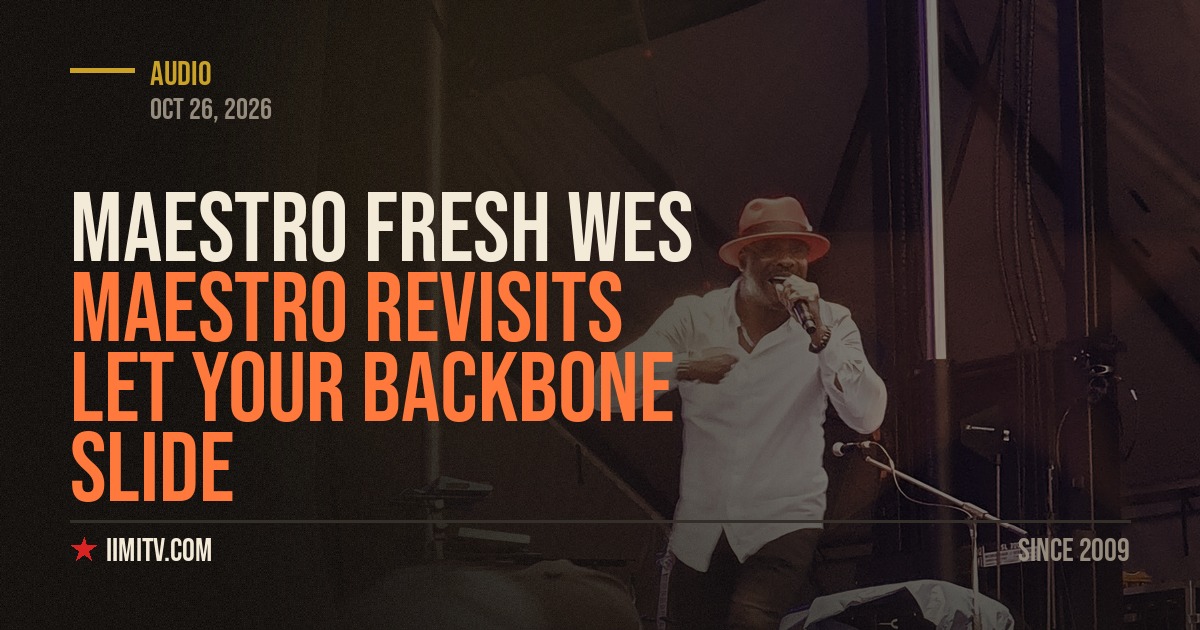
Maestro Fresh Wes released Let Your Backbone Slide in 1989, and tonight, October 26, 2026, the song receives the Cultural Impact Award at the SOCAN Awards at REBEL in Toronto. This is a catalogue deep dive, stated plainly: the record being honoured is 37 years old, and its award is for what it started.
The song was the debut single from Maestro’s first album, Symphony in Effect, released in 1989. It became the first Canadian rap single to reach gold status, a threshold no artist from this country had crossed in the genre before. In 1989, Canadian hip hop had no established radio path, no dedicated chart infrastructure and no major label template to follow. Let Your Backbone Slide built a proof of concept in real time, in the market, with sales.
Let Your Backbone Slide: What the SOCAN Honour Recognises
SOCAN credits the song to writers Maestro Fresh Wes, Anthony Davis and Peter Davis, with BMG Rights Management Canada, on behalf of BMG Rights Management (US), and Warner Chappell Music Canada listed as publishers. The Cultural Impact Award sits in the special achievement group at this year’s ceremony, alongside Drake as Songwriter of the Year, Performer, and Jessie Reyez receiving the International Achievement Award, in an evening hosted by Arisa Cox and Andrew Phung with more than 100 creators and publishers honoured.
The placement matters. The same night that honours the biggest Canadian songwriter of the streaming era also formally honours the song that opened the commercial door his genre walked through. That is not nostalgia programming. It is the industry writing its own lineage into the record, in the correct order.
The Record Itself, Revisited
Listening now, the song’s construction explains its reach. It is built for movement, a dancefloor record with a repeated title hook simple enough to cross every barrier a Canadian rap single faced in 1989: unfamiliar genre, no radio format, no video rotation guarantee. The performance is confident and clean, pitched at a general audience without sanding down the fact that it is a rap record. That balance is precisely why it could travel where earlier Canadian attempts had stalled.
Symphony in Effect, the album it launched, went on to anchor a national first chapter for the genre, and Maestro’s career extended across music, acting and broadcasting in the decades that followed. But the catalogue always comes back to this single, because it holds the measurable first: the first gold rap single in Canada, achieved by a Toronto artist working inside a scene that the industry had not yet learned how to sell.
Why This Song Still Anchors Canadian Hip Hop History
Every scene history format needs a starting document, and for canadian hip hop this is the one that carries the weight. Not the first Canadian rap recording ever made, a claim historians can argue, but the first to convert into certified commercial success, which is the specific barrier that determines whether a scene gets infrastructure built around it. Gold in 1989 meant labels, promoters and broadcasters had a number they could not wave away.
The line from that number to the present is documented rather than sentimental. Toronto’s scene produced the artists who now lead the SOCAN honours list in the same ceremony. Tonight’s Cultural Impact Award closes the loop in one room: the song that proved Canadian rap could sell, honoured on the night Canadian songwriting celebrates its global era. For catalogue listeners, the deep dive takeaway is simple. Play Let Your Backbone Slide first, then Symphony in Effect in full, and hear the foundation record of the country’s hip hop story in its original form.
The Room Where It Lands Tonight
The ceremony setting adds a layer that a history piece should not skip. The SOCAN Awards take place at REBEL, a Toronto waterfront venue, in the city where Maestro built the record. The honourees list for the night runs to more than 100 creators and publishers across performance, songwriting and screen composition, including Peter Peter receiving the Global Impact Award for his work connected to Heated Rivalry and Andrew Lockington named Screen Composer of the Year. The Cultural Impact song sits inside that full picture of Canadian writing in 2026, not in a heritage corner of it.
That is the correct frame for the honour. Cultural impact, as a category, is about what a work set in motion, and few Canadian songs can show a straighter line between a single release and an industry that followed. The gold single came first. The infrastructure, the award categories, the global stars and nights like tonight came after.