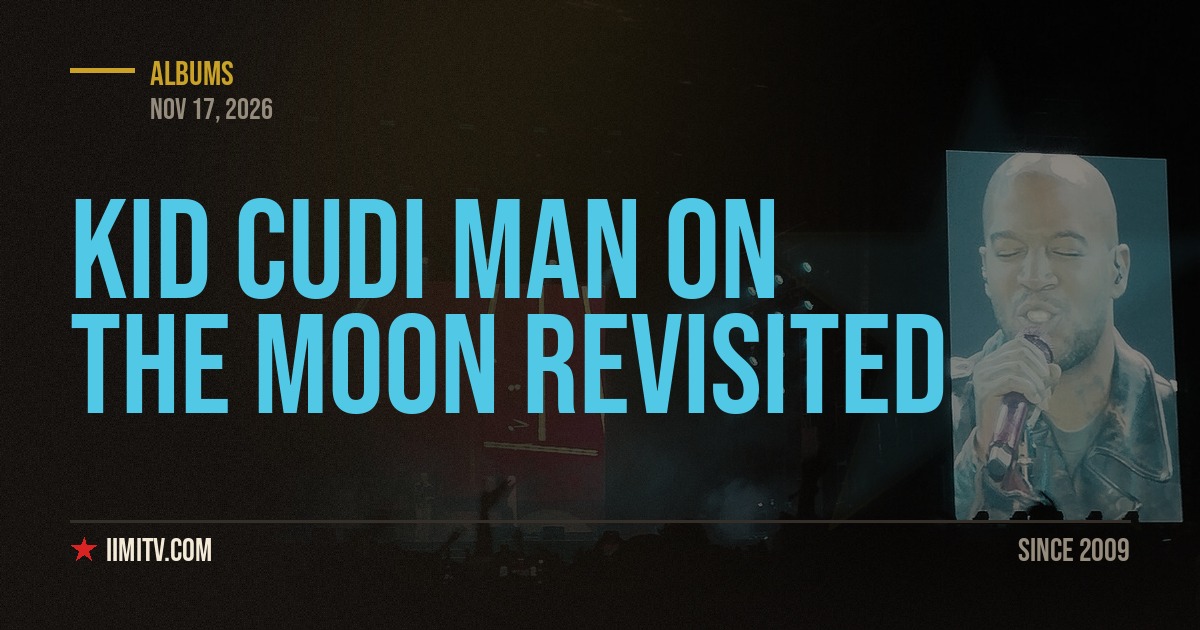
Kid Cudi released Man on the Moon: The End of Day on September 15, 2009, through Dream On, GOOD Music and Universal Motown Records. This revisited look traces how Kid Cudi Man on the Moon turned a five-act concept album about loneliness into a blueprint for the emotional rap that followed it.
Kid Cudi Man on the Moon, told in five acts
The album runs 15 tracks across five acts, narrated by Common, and it follows the momentum of Cudi’s 2008 mixtape A Kid Named Cudi. The structure matters because the songs are sequenced as one journey rather than a stack of singles: “Soundtrack 2 My Life” sets out the family history and the losses underneath the record, “Day ‘n’ Nite” and “Sky Might Fall” carry the middle stretch, and “Enter Galactic (Love Connection Pt. I)” opens the door to the stranger, more hopeful back half.
Join The iimiTV Letter
Enter your email and we will send you a confirmation link. Click it and your first edition lands on Friday.
The production team explains the sound. Emile Haynie, Plain Pat, Dot da Genius, Ratatat and Kanye West all handle production across the tracklist, and the record blends alternative hip hop with psychedelia, indie pop, electronica and rock. In 2009 that mix was the exception in mainstream rap. A decade of melodic, confessional rap later, it reads as an early draft of the mainstream.

Three singles carried the record
“Day ‘n’ Nite” came first, released as a single on February 5, 2008, before the album existed. It peaked at No. 3 on the Billboard Hot 100, remains Cudi’s highest-charting song, and has since been certified diamond in the United States. “Make Her Say,” featuring Kanye West and Common, followed on June 9, 2009. The third single, “Pursuit of Happiness,” featuring MGMT and Ratatat, arrived on January 25, 2010, and it is also certified diamond, a rare outcome for a third single from a debut album.
The three singles map the album’s range on their own: a lonely night record, a playful posse cut, and a euphoric song about the cost of chasing a high. Each one is built on the same tension that runs through the full album, celebration on the surface and something heavier underneath it.
The numbers behind the debut
Man on the Moon: The End of Day debuted at No. 4 on the Billboard 200 in the week ending September 23, 2009, selling 104,000 copies in its first week. The three albums ahead of it that week were Jay-Z’s The Blueprint 3, Whitney Houston’s I Look to You and Muse’s The Resistance, which puts the debut’s opening in its proper context: a new artist with one hit single opening behind three established chart powers.
The album stayed on the chart for more than 110 weeks and was certified four times platinum by the RIAA as of December 2022. It also earned three Grammy nominations. Those are catalogue numbers, not first-week numbers, and they explain why this record keeps resurfacing in essential-album conversations while many bigger openers from 2009 do not.
“My mission from day one is two things: to help kids not feel alone and stop kids from committing suicide.”
Cudi said that on The Arsenio Hall Show in 2014, in remarks SPIN later traced through years of fans crediting his music with pulling them through dark periods. The mission statement was not a retrospective invention. It is the same subject matter the debut album was already working through in 2009, five years before he said it on television.
Why the album is back in focus this week
On November 15, Cudi announced a dance album, Visions in the Night, arriving in December under the name RAGER. Reporting on his announcement, including HOT 96.9’s account of the studio video, says he built the instrumental project in two days in Paris, across sessions on November 14 and 15, and that it stands apart from a separate rap album he has already finished.
That detour makes more sense with the debut in view. The electronic and indie textures that sit inside Man on the Moon, from the Ratatat collaboration to the album’s synth-heavy middle acts, were there from the start of his catalogue. Seventeen years on, the debut is not just a period piece. It is the record that explains where its maker is still willing to go.