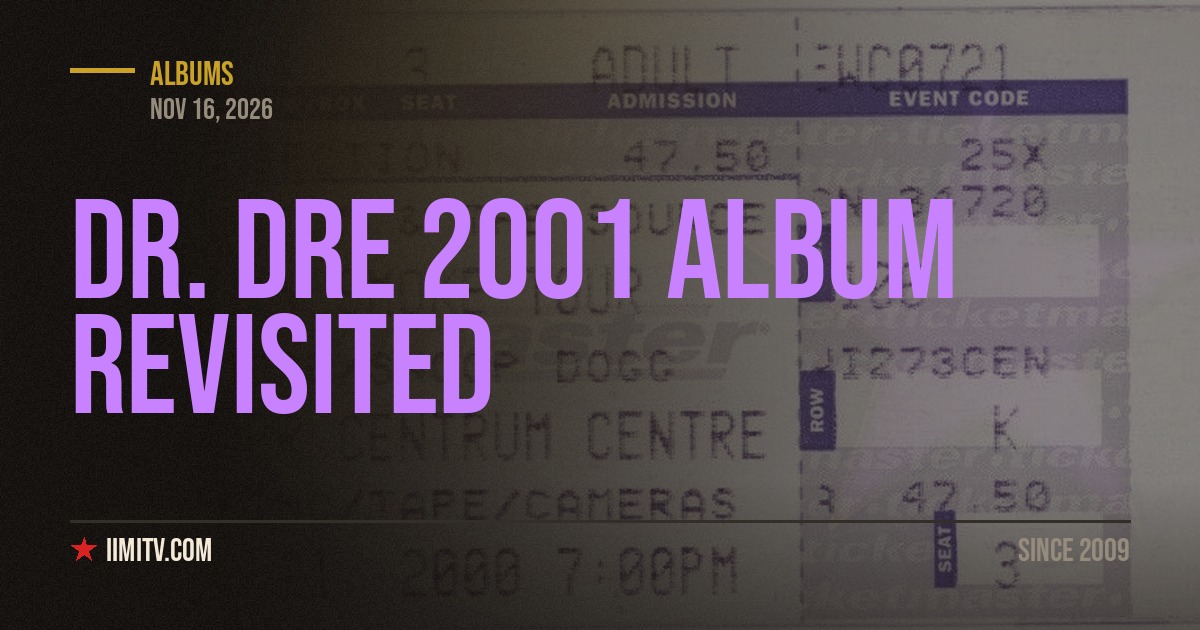
Dr. Dre released 2001 on November 16, 1999, through Aftermath Entertainment and Interscope Records, and the album turns twenty seven years old today. The Dr. Dre 2001 album was his second studio record and his first solo album since The Chronic in 1992, and it answered every question about whether he still ran West Coast rap.
The title itself carries the comeback story. The record was first pitched as a Chronic sequel under the name Chronic 2000, but a trademark fight with Death Row Records and its distributor Priority, who used the same name for a compilation, pushed Dre to simply call it 2001. Produced mainly by Dr. Dre and Mel-Man, with Lord Finesse also contributing, the album expanded the G-funk sound of The Chronic into something cleaner, colder and built for a new decade.
Join The iimiTV Letter
Enter your email and we will send you a confirmation link. Click it and your first edition lands on Friday.
Dr. Dre 2001 album, by the numbers
The commercial record is exact. 2001 debuted at number two on the Billboard 200 with 516,000 copies sold in its first week, held off the top spot only by Korn and their album Issues, and it entered at number one on the Top R and B and Hip-Hop Albums chart. The RIAA certified it six times platinum on November 21, 2000, and United States sales reached 7.8 million by August 2015, making it the best selling album of Dr. Dre’s career, ahead of The Chronic and its triple platinum run.
The guest list reads like a West Coast summit: Snoop Dogg, Eminem, Xzibit, Kurupt, Nate Dogg, Hittman and Mary J. Blige all appear, alongside a new generation of Aftermath voices the album was designed to introduce. The album closed out its chart run as the number five album on the Billboard 200 year end list for 2000, and its closing track The Message, with Mary J. Blige, remains the record’s most personal moment.
Three singles that never left
The album produced three singles, and all three are still in rotation. Still D.R.E., released in October 1999 with Snoop Dogg, was written by Jay-Z and built on the piano line Scott Storch played, the session that began Dre’s long collaboration with the keyboardist. The song reached number six in the UK, and its video won Best Rap Video at the 2000 MTV Video Music Awards. Forgot About Dre, featuring Eminem, hit number twenty five on the Hot 100 and won the Grammy for Best Rap Performance by a Duo or Group at the 2001 awards. The Next Episode, again with Snoop Dogg, peaked at number twenty three on the Hot 100 and number three in the UK.
Still D.R.E. earned a Grammy nomination for Best Rap Performance by a Duo or Group, and Forgot About Dre won the same category a year later, while the album itself was nominated for Best Rap Album.
Why 2001 still frames the West
The album is widely credited with bringing West Coast hip hop back to the spotlight after years in the background, and with proving Dre could stay prominent with a completely new generation of listeners. The production template, Mel-Man’s co-production, Storch on keys, orchestral strings over G-funk bass, became the sound other producers chased into the 2000s. Eminem’s appearances, months after his own major label arrival, also fixed the Aftermath blueprint: one veteran architect, one new headline voice, and a roster presented as a movement.
Twenty seven years on, the clearest measure is simple. Still D.R.E. opens sets, The Next Episode closes parties, and Forgot About Dre remains the reference point for a producer and his protege trading verses at full speed. Albums that shape a sound get revisited. Albums that reset a coast get a date on the calendar, and for 2001 that date is November 16.