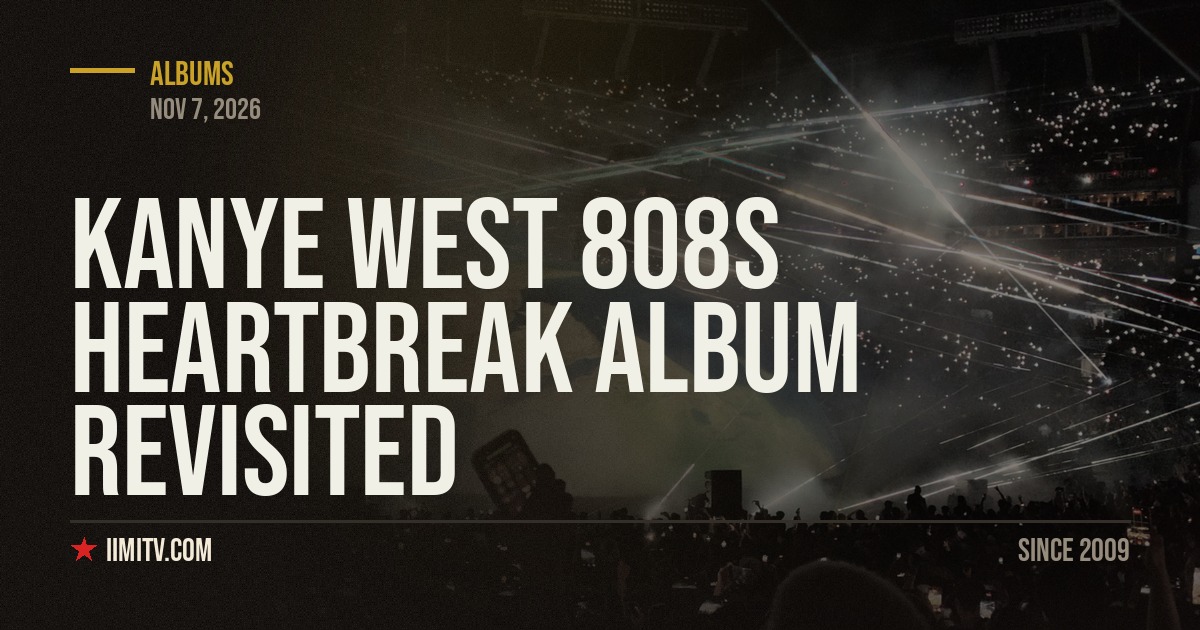
Kanye West released 808s & Heartbreak, his fourth studio album, on November 24, 2008, through Def Jam Recordings and Roc-A-Fella Records. This 808s & Heartbreak album revisited piece returns to the record 18 years on: it is a catalogue album, not new music, and it remains the most influential left turn in modern rap.
The commercial numbers were never the problem. The album debuted at No. 1 on the Billboard 200 with 450,145 copies sold in its first week, reached No. 4 on the Canadian Albums Chart, and has since been certified 3x Platinum in the United States and Platinum in Canada. What divided listeners in 2008 was the sound: a rapper at his commercial peak choosing to sing, through Auto-Tune, over cold synths and a Roland TR-808.
Join The iimiTV Letter
Enter your email and we will send you a confirmation link. Click it and your first edition lands on Friday.
808s & Heartbreak Album Revisited: The Sound
West recorded the album in September and October 2008 at Glenwood Studios in Burbank and Avex Recording Studio in Honolulu, working with producers including No I.D. and Jeff Bhasker. The palette is minimal by design: heartbeat kick drums, icy piano, strings used sparingly, and a voice processed until it sounds like it is singing from inside a machine. Tracks like “Say You Will” and “Welcome to Heartbreak” leave open space where a Graduation era record would have stacked samples.
The singles carried the experiment to radio anyway. “Love Lockdown,” released September 18, 2008, debuted at No. 3 on the Billboard Hot 100, the highest debut of West career to that point. “Heartless” debuted at No. 4, climbed to No. 2, and has been certified 7x Platinum by the RIAA. “Amazing” with Young Jeezy and “Paranoid” with Mr Hudson followed, and Kid Cudi, then an emerging artist in West orbit, helped shape the album melodic language from inside the sessions.
The Guests Point Forward
The feature list reads like a map of where rap was heading. Kid Cudi presence connects the album directly to the melodic, emotionally open style he would take mainstream the following year. Lil Wayne appears on “See You in My Nightmares” at the peak of his own commercial run, meeting West in a register closer to rock than to the soul rap both men came from. Mr Hudson, a British singer few American listeners knew, takes “Paranoid” and a co-lead on “RoboCop,” an early example of West using an unknown voice as an instrument rather than a marketing line.
That openness is the album lasting export. Within two years, Drake, a Canadian artist who has repeatedly named West as a formative influence, was building hits on the same foundation: singing and rapping in the same song, Auto-Tune as expression rather than correction, heartbreak as a headline subject. The line from 808s to the Toronto sound of the 2010s is not a theory. It is audible in the records themselves, and it is a large part of why a Chicago album from 2008 still anchors conversations about Canadian hip hop in 2026.
Why It Holds Up
Revisited today, the album coherence is its strength. Twelve tracks, one emotional weather system, no wasted features and no return to the old sound for safety. The records that followed it, from West own My Beautiful Dark Twisted Fantasy to a decade of melodic rap, absorbed its lessons so completely that 808s can sound normal now. That is the mark of a record that changed the defaults. Eighteen years after November 24, 2008, 808s & Heartbreak is not the strange detour in the Kanye West catalogue. It is one of the load bearing walls.