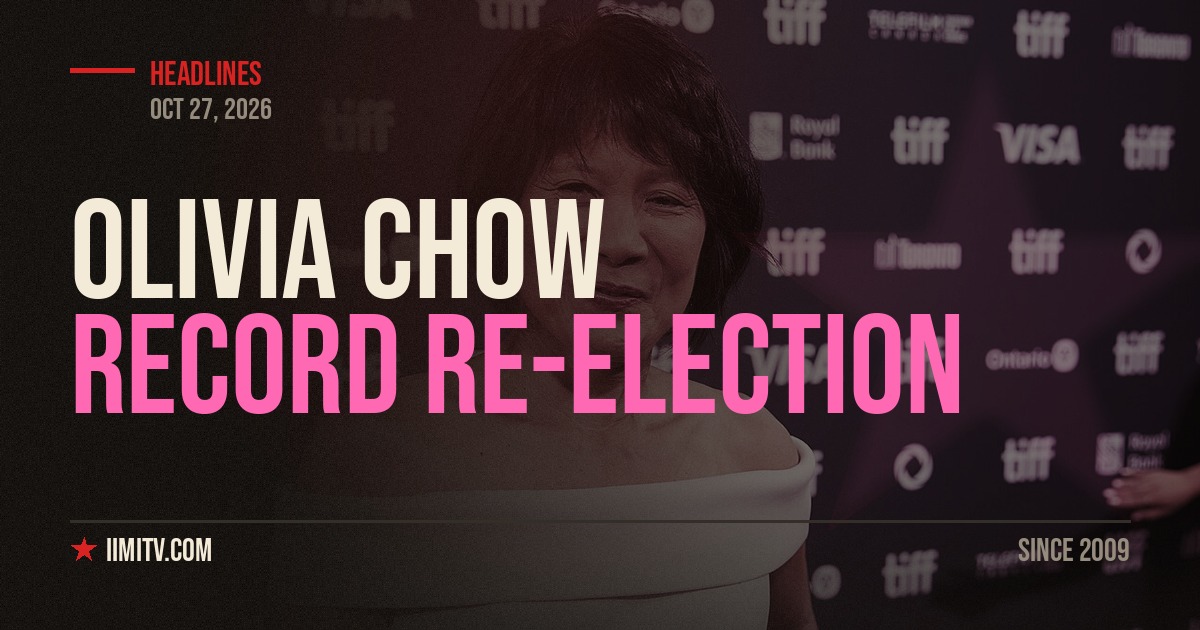
Olivia Chow has been re-elected mayor of Toronto, defeating Brad Bradford in the municipal election held Monday, October 26, 2026, with 54.16 per cent of the vote. Her total of 532,201 votes is the most ever received by a Toronto mayoral candidate, clearing the record Mel Lastman set in 2000 by close to 49,000 votes.
The win gives Chow her first full four-year term at City Hall. She first took the mayor’s office in the June 2023 by-election called after John Tory resigned, stepping into a term already in progress. Monday’s result changes the footing: the mandate is now hers from the start of a term, running through 2030, and it arrived with a turnout surge the city has not seen in a municipal vote in decades.
Toronto Mayor Election Results, By The Numbers
The final unofficial count was not close. Chow finished with 532,201 votes and 54.16 per cent of the ballots cast for mayor. Bradford, the Beaches-East York councillor who gave up his council seat to run, took 404,013 votes and 41.11 per cent. The margin between them was 128,188 votes, or just over 13 percentage points, in a race that began with 53 names on the ballot and narrowed to a two-person contest.
Turnout is the number underneath the result. Participation reached 45.84 per cent, up 7.34 percentage points, against 29 per cent in the 2022 municipal election, a record low, and roughly 38.5 per cent in the 2023 by-election. Advance voting pointed to the surge early: about 222,000 ballots were cast before election day, up nearly 72 per cent from the by-election, according to CBC reporting on the early vote. Chow carried 19 of the city’s 25 wards, including Bradford’s home ward of Beaches-East York, and became the first mayoral candidate in Toronto history to pass half a million votes. Lastman’s previous record, 483,277 votes in 2000, had stood for 26 years.
How The Night Unfolded
For most of the campaign’s final stretch, the race looked tighter than it finished. Polls in the last week put Chow ahead by five to ten points, and a Forum Research survey on October 25 had her at 53 per cent. But a Liaison Strategies poll in mid-October had Bradford in front, 49 to 47, and Chow spent the closing days warning her supporters the contest would be, in her words, “neck and neck.”
Election night briefly matched that billing. Bradford led the earliest returns as the first polls reported, then Chow moved ahead as results came in from across the city and never gave the lead back. CP24 and CTV both projected her victory while ballots were still being counted. Bradford conceded the same night, saying of Chow that “she is the mayor and nobody can doubt that.” Chow thanked Bradford for bringing new energy and new ideas to the race and said she is mayor for everyone in the city, including the people who voted against her. The results remain unofficial until the City Clerk certifies them.
She put the same message to supporters on X on election night: “Tonight, the people of Toronto have spoken. And you have given me the extraordinary honour of continuing to serve as your mayor. I am grateful. I am humbled. And I am so proud of our city.”
Seven New Faces On Council
Torontonians were not only choosing a mayor on Monday. All 25 city council seats were on the ballot, and seven of them will have new faces when the new municipal term begins on November 15, 2026. The most watched local race sat in Beaches-East York, the ward Bradford vacated to run for mayor, where former Liberal MP Nate Erskine-Smith won the seat. Chow endorsed a slate of council candidates during the campaign, and several of them were elected, which shapes the working relationship between the mayor’s office and the chamber for the term ahead.
The turnover matters because so much of the city’s business runs through council votes rather than the mayor alone. Budgets, transit funding, permits, bylaws and planning decisions all land in that chamber. Chow now opens a full term with a council that is part returning, part new, and elected on the same night and the same turnout wave that produced her record vote.
What A Full Chow Term Means For Toronto Culture
City Hall is also the backdrop for Toronto’s culture life, and a settled four-year term sets the conditions the scene works under through 2030. The permits and road closures behind the city’s street festivals and parades, the rules its venues and nightlife operate under, TTC service levels on big event nights, and city support for arts and music organizations all run through the mayor’s office and council. None of that is decided by an election result, but all of it is decided in the building Monday’s vote just staffed.
Chow’s 2026 platform, as reported through the campaign, centred on affordability: holding property tax increases around the rate of inflation, adding supportive housing and shelter capacity, and protecting public services. On transit, her campaign leaned on a TTC fare freeze and fare capping, the system under which riders stop paying after a set number of trips in a period. For a city whose concerts, festivals and arena nights move on transit, the practical questions of the term are concrete: how permitting timelines run for the summer festival calendar, how much service is on the street when 20,000 people leave a venue at once, and how the city’s marquee events are supported year to year.
The new term begins November 15, 2026, and its first major test is the 2027 city budget. Toronto showed up for this election in numbers it usually reserves for federal and provincial votes, and it handed its mayor a record mandate to open a full term. What that mandate builds is now the story.