Shad released The Old Prince on October 23, 2007 through Black Box Recordings. This is a catalogue album, framed as catalogue: nothing here is new, and the record still matters because it is the album where the London, Ontario rapper, born Shadrach Kabango, turned a debut’s promise into a national argument, thirteen tracks of precise, funny, self-questioning writing that the Junos and the Polaris Music Prize both had to reckon with the following year.
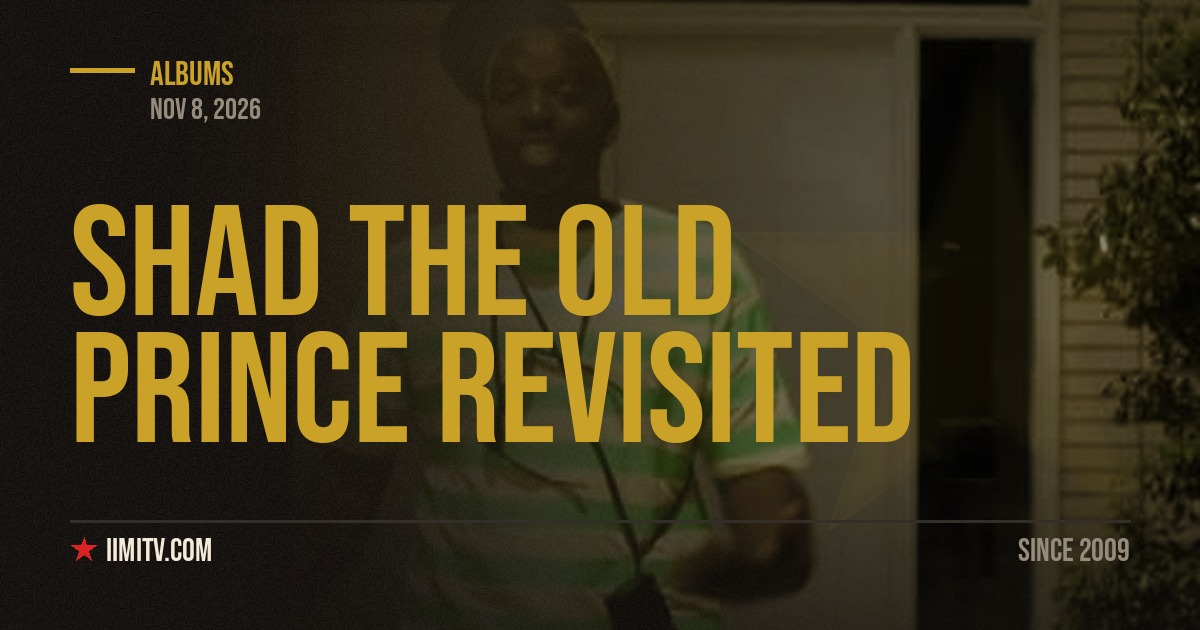
It was his second studio album, following 2005’s When This Is Over, and its title character is its thesis: a prince who has not left home, royalty by talent and a tenant by circumstance. The official video for “The Old Prince Still Lives At Home,” embedded below, plays that joke at full size, a shot-for-shot spoof of The Fresh Prince of Bel-Air opening credits with Shad in the striped shirt and sideways cap, arriving not at a mansion but at his parents’ house.
Join The iimiTV Letter
Enter your email and we will send you a confirmation link. Click it and your first edition lands on Friday.

Thirteen Tracks, Forty Minutes, A Dozen Producers
The album runs 13 tracks in 40 minutes and 26 seconds, as its reference listing shows: “Intro: Quest for Glory,” “I Don’t Like To,” “What We All Want” featuring Kamau and Rel McCoy, “Brother (Watching)” featuring B and F. Kabango, “Now A Daze,” “The Old Prince Still Lives At Home,” “Out of Love Pt. 2,” “The Last Three Years (Interlude),” “I Heard You Had a Voice Like an Angel / Psalm 137,” “Compromise,” “Exile,” “Get Up” and “Outro.” The producer credits read like a census of the era’s Canadian underground: Rel McCoy, Slakah the Beatchild, AMiracle, Ric Notes, Mantis, Mad Scientist and Shad himself among them, a community record built by many hands around one unmistakable voice.
Four of those tracks received videos: “I Don’t Like To,” “Brother (Watching),” “Compromise” and the title spoof. That spread is the album in miniature. “Brother (Watching)” brings his own family, the Kabangos, into a song about watching and being watched over. “I Heard You Had a Voice Like an Angel / Psalm 137” stretches past five minutes into scripture and exile, themes his Kenyan roots and his faith put in his writing years before they became his public signature. And the comedy record, the one everyone remembers first, is the title track.
The Joke That Carries The Whole Album
“Yo, I live at home still, not paying phone bills, hydro or rent,” he raps on “The Old Prince Still Lives At Home,” and the laugh lands because the writing around it is so exact. The song is a young artist’s honest ledger: the talent is real, the income is not, and the distance between the two is where the album lives. The video won CBC Radio 3’s 2008 Bucky Award for Best Video, which means the spoof outran the song’s own scene and landed with a national audience that had never heard a Shad verse.
That balance, the joke on the surface and the accounting underneath, is why the album aged the way it did. Plenty of rappers in 2007 were writing about arrival. Shad wrote about almost arriving, in a house he did not own, with a family’s voices on the record and a psalm in the tracklist, and made the almost more interesting than most arrivals.
Juno And Polaris Both Called In 2008
The album was nominated for Rap Recording of the Year at the 2008 Juno Awards and shortlisted for the 2008 Polaris Music Prize. For a self-released-feeling independent record from London, Ontario, those two nominations together were a verdict: the writing was not a regional secret anymore. Three years later he would win the Juno outright with TSOL, the album revisited in our return to TSOL, but the case that album won on was first built here.
Heard now, The Old Prince holds up as the foundation document of one of Canadian hip hop’s most decorated careers: the humour, the faith, the family, the footwork of the verses, all present in 2007, all in forty minutes. Released on October 23, 2007, it remains the record where Shad first sounded like Shad, a prince in his parents’ house, writing like the throne was a detail he could afford to laugh about.