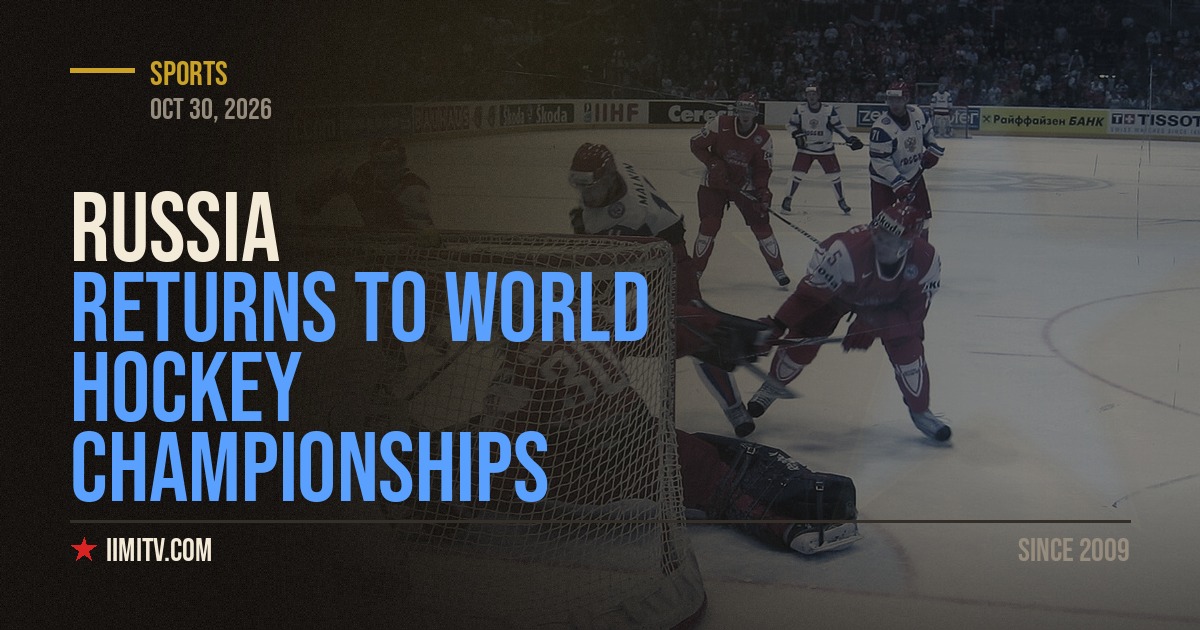
The Court of Arbitration for Sport ruled on Friday, October 30, 2026, that Russian hockey teams must be allowed back into World Championship competition, ending a ban that has kept Russia out of international hockey since February 2022. The Russia hockey world championship return begins with the 2027 World Junior Championship in Canada this December.
The ruling is not a narrow one. A CAS panel set aside the International Ice Hockey Federation Council decision that had extended Russia’s exclusion through the 2026-27 season, and it did so with immediate effect. Russian teams are now cleared for five championships in 2027, the IIHF says it will act in accordance with the ruling, and a rivalry that defined generations of Canadian hockey is suddenly back on the calendar, starting on Canadian ice.
Russia Hockey World Championship Return Starts With The World Juniors In Canada
The list of tournaments in the CAS award covers every level of the game. It opens with the World Junior Championship in Canada from December 26, 2026 to January 5, 2027, the tournament Sweden Herald reports will be played in Edmonton and Red Deer. After that come the U18 Women’s World Championship in the Czech Republic from January 8 to 16, 2027, the U18 Men’s World Championship in the United States from April 22 to May 2, 2027, the Men’s World Championship in Germany from May 14 to 30, 2027, and the Women’s World Championship in Canada in November 2027.
For a Canadian audience, the order of that list is the story. The first major tournament Russia re-enters is the World Juniors, the holiday tournament Canada treats as its own, in two Alberta rinks. The last one on the list brings the Russian women’s team to Canada as well. Canada and Russia have decided gold medals against each other at every level of this sport, and for more than four years that matchup simply did not exist in IIHF competition. It exists again now, and the panel’s reasoning was blunt. CAS said the panel “found that the IIHF arguments citing safety, security and other concerns were not supported by sufficient evidence,” and that only substantiated security concerns could outweigh the right of athletes of a particular nationality to take part.
Read the ruling itself in the CAS media release, and the federation response in the IIHF statement on the CAS decision.
Four Years Out Of The Game Ends With One Hearing In Lausanne
The exclusion began on February 28, 2022, days after Russia’s invasion of Ukraine, when the IIHF Council suspended all Russian and Belarusian national teams and clubs from every age category and stripped Russia of the 2023 World Junior Championship hosting rights. Russia has not played at a senior World Championship since the 2021 tournament, and Russian teams also missed the Olympic hockey tournaments this year. What looked like a settled position then spent 2026 coming apart in stages.
In January 2026, the IIHF Council decided not to reintegrate Russian teams for the 2026-27 season, citing safety and security concerns. The Russian Ice Hockey Federation appealed to the IIHF Disciplinary Board, which annulled that decision in May 2026 and sent the matter back for a fresh analysis. The Council reviewed it again and maintained the exclusion. The two federations then agreed to skip the remaining internal steps and send the case directly to CAS for a final ruling. The hearing ran in person at CAS headquarters in Lausanne on October 23 and 26, 2026, before a panel of Giulio Palermo of Italy, Ismail Selim of Egypt and Mark Hovell of the United Kingdom. The panel was unanimous.
Two limits on the award matter as much as the result. CAS set aside the Council decision with immediate effect, but it did not order a neutrality regime, and it did not rule on organizational consequences, because neither was part of the appeal. Whether Russian teams play under their own name, flag and anthem, or under some neutral arrangement, is therefore still an open question the ruling deliberately leaves behind. The award is operative only for now, with the full grounds to follow, and Friday’s decision covers Russia alone: Belarus was not the appellant in this case and is not named in the award.
The IIHF Says It Will Comply, And Warns The Work Starts Now
The federation did not hide its reaction. “The International Ice Hockey Federation (IIHF) expresses its disappointment with the decision of the Court of Arbitration for Sport (CAS) to allow the Russian Ice Hockey Federation in entering a Russian Team in all IIHF Championships with immediate effect,” the IIHF statement reads. “The IIHF disagrees with this aspect of the ruling and maintains that its decisions were necessary to protect the safety and security of all participants and safeguard the integrity of its competitions. While the IIHF respects the authority of CAS and will act in accordance with its ruling, the outcome does not remove the concerns that informed its assessments.”
The practical problem is real, and it is immediate. The IIHF notes that the ruling lands on competitions already at an advanced stage of preparation, with group divisions and schedules for the men’s and women’s World Championships already determined. Fitting Russia back in requires coordination with national associations, organizing committees and host authorities, plus a review of formats, schedules, travel, accommodation and security measures. The federation says it will urgently assess the steps and time required, with further information to come. The timing is also a test for new IIHF president Franz Reindl, whose home country, Germany, hosts the men’s World Championship next May in Düsseldorf and Mannheim.
Reaction outside the federation split along predictable lines. Sweden’s sports minister Jakob Forssmed called the decision remarkable and offensive in comments to TT, arguing that nothing has changed while Russia’s war against Ukraine continues. In Russia, sports minister Mikhail Degtyaryov wrote that CAS had recognized the Russian federation’s demands on key points as justified. The IIHF, caught between the court order and those reactions, has committed to one thing only so far: compliance.
What Russia’s Return Changes On The Ice
Strip away the legal fight and the hockey consequence is simple: the deepest talent pool outside the NHL is eligible again. Russian players have kept starring in the NHL throughout the ban, but they could not wear their national colours at any IIHF event. That changes the competitive map of every tournament on the CAS list. A World Junior field in Edmonton and Red Deer now has to make room for a Russian team two months from puck drop, in a tournament where Canada-Russia games have produced some of the most watched nights in Canadian sports television.
What nobody can answer yet is the shape of the return. The IIHF has not said how Russia slots into groups and schedules that were built without it, whether any tournament field expands, or what conditions, if any, attach to the Russian name and symbols. Those answers sit with the federation’s urgent assessment, not with the court. What the court settled on Friday is the only question it was asked: the ban, as the IIHF defended it, did not have the evidence behind it. After more than four years, and a full generation of junior players who never got to play in these tournaments, Russia is back in world championship hockey, and its first stop is Canada.