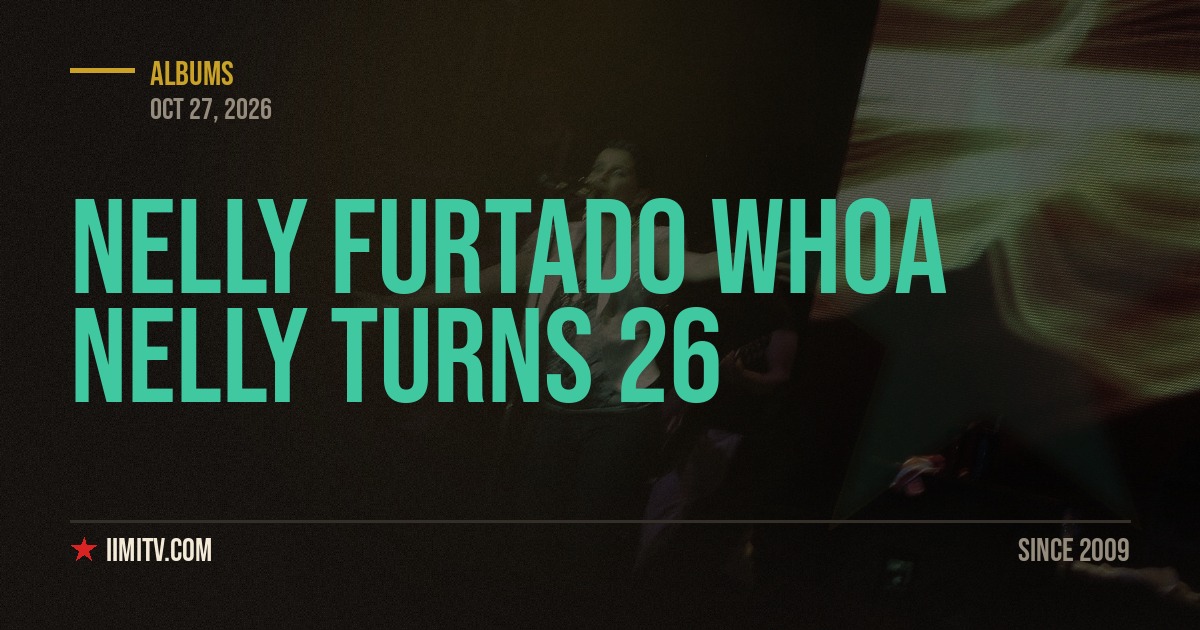
Nelly Furtado released her debut album Whoa, Nelly! on October 24, 2000, through DreamWorks Records. Twenty six years on, the record stands as one of the most original debuts Canadian pop ever produced, a folk, pop, hip hop, R&B and bossa nova blend that peaked at No. 2 in both Canada and the United Kingdom and sold six million copies worldwide by August 2006, according to Maclean’s.
The anniversary is a useful moment to revisit what the album actually did. Furtado was a Portuguese Canadian singer from Victoria, British Columbia, whose parents had immigrated from the Azores. She moved to Toronto after high school, performed at the Honey Jam talent showcase, and was spotted by Gerald Eaton of The Philosopher Kings. Eaton and bandmate Brian West helped her record a demo, signed on as her co-producers, and built Whoa, Nelly! with her in Toronto studios.
Whoa Nelly At 26: A Toronto Made Debut
The Toronto part of this story is not decoration. The album’s producers came out of a Canadian funk and soul band, its singer was discovered at a Toronto showcase built to spotlight young women in urban music, and its sound carried the city in its mix: Portuguese language passages in “Scared of You” and the fully Portuguese “Onde Estás,” trip hop rhythms beside acoustic guitar, and a writing voice that treated genre borders as suggestions. Few debuts anywhere in 2000 sounded like their city the way this one sounded like Toronto.

I’m Like A Bird And The Singles Run
The lead single, “I’m Like a Bird,” was released September 25, 2000, written by Furtado and produced by Eaton and West. It reached No. 9 on the Billboard Hot 100, No. 1 in Portugal, and the top ten in the United Kingdom, Australia and Ireland. At the 2002 Grammy Awards the album earned four nominations and “I’m Like a Bird” won Best Female Pop Vocal Performance, a remarkable haul for a debut artist on a first single.
The follow ups proved the debut was no accident. “Turn Off the Light” climbed into the top five in the United States and the United Kingdom and topped charts in several territories, with a remix history that connected Furtado to Timbaland years before their Loose era partnership. “…On the Radio (Remember the Days)” and “Hey, Man!” completed a singles run that kept the album on charts well into 2002, supported by her Burn in the Spotlight Tour and a slot on Moby’s Area:One tour.
A delightful and refreshing antidote to the army of pop princesses and rap-metal bands that had taken over popular music at the turn of the millennium.
That was Slant Magazine on the album, and the line has aged well because it names what listeners heard: a singer songwriter record that borrowed from hip hop production without costume, and from Portuguese folk without apology. The album has since passed a billion streams across its tracks and earned double platinum certification in the United States, numbers that arrived long after its first chart life ended.
Why The Debut Still Matters
The clearest measure of Whoa, Nelly! is what it made possible. It proved a Canadian artist could enter global pop on her own terms, writing and co-producing her material, singing in two languages, and refusing a single lane. Furtado’s later turns, the folk leaning Folklore, the Timbaland driven Loose with its No. 1 singles “Promiscuous” and “Say It Right,” and the Spanish language Mi Plan, all extend the same instinct that the debut announced: follow the song, not the category.
The catalogue has been cared for in public. A 20th anniversary digital edition in October 2020 added ten bonus tracks, five of them previously unreleased, and in August 2024 the album reached vinyl for the first time as a deluxe two LP set with five bonus tracks, including an acoustic “I’m Like a Bird” and a Dan the Automator mix of “…On the Radio.” Those editions matter because they show the debut being treated as a living document rather than a nostalgia item, remixed, expanded and reissued for listeners who found it on streaming first.
Twenty six years on, the album also reads as a Toronto document. A generation of Canadian pop artists who treat genre as raw material, from Jessie Reyez to Tate McRae, works in a business where a Toronto made, globally fluent debut is a known possibility. In October 2000, it was a gamble by a 21 year old from Victoria and two producers from The Philosopher Kings. The gamble is now part of the foundation this site covers every day.