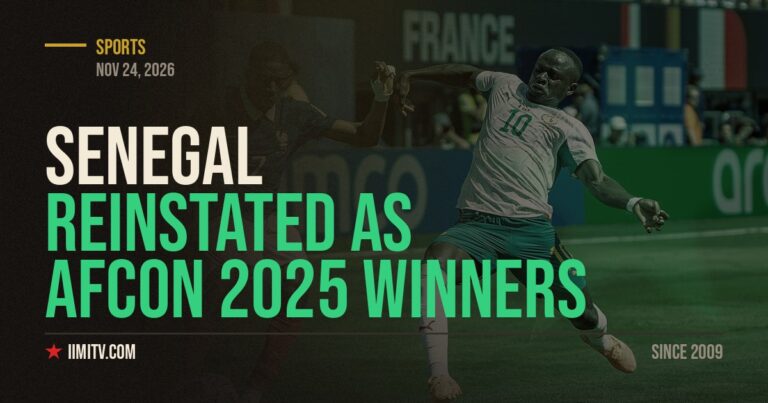
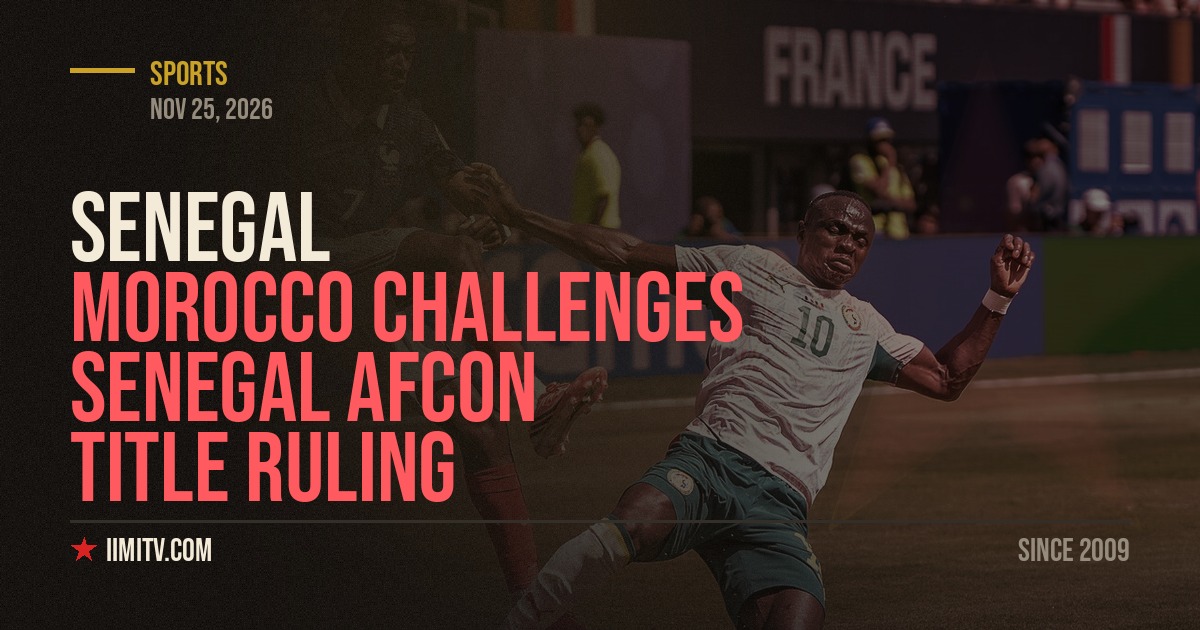
Senegal are the Africa Cup of Nations champions again, and the title is now being fought over for a third time. Yesterday, Tuesday, November 24, 2026, the Court of Arbitration for Sport (CAS) ruled unanimously that Senegal’s 1-0 extra-time win over Morocco in January’s final stands, restoring the Teranga Lions as AFCON 2025 winners ten months after they lifted the trophy in Rabat and eight months after CAF’s Appeal Board took it away.
FINAL: Senegal 1, Morocco 0
Join The iimiTV Letter
Enter your email and we will send you a confirmation link. Click it and your first edition lands on Friday.
The sporting question looked closed on Tuesday. By Wednesday morning it had a new legal chapter: Morocco’s federation has announced it will challenge the CAS award itself, CAF has pledged to implement the ruling, and Senegal’s captain Sadio Mane has used his first public words on the verdict to call the two countries brother nations.
Morocco Challenges The Senegal AFCON 2025 Winners Award
The Royal Moroccan Football Federation (FRMF) objected, in its statement, to the fact that its request was not taken into consideration, as Reuters reported in its reaction roundup. The request concerned what Morocco called confirmed contact between German arbitrator Ulrich Haas, one of the three judges on the CAS panel, and Senegalese federation president Abdoulaye Fall 48 hours before the ruling was issued. “Consequently, the Royal Moroccan Football Federation has decided to initiate all necessary legal proceedings to challenge the CAS decision,” the statement said.
CAS answered the timing point directly. Secretary General Matthieu Reeb acknowledged to reporters in Lausanne that a Moroccan protest was received just minutes before the verdict was announced, and that the court’s challenge panel found there were not enough elements at that stage to postpone notification of the award. “There could only be one winner in this final, just as there could only be one winner in this legal process. The law has spoken,” Reeb said. Senegal’s side rejected the allegation outright: federation lawyer Patrick Kabou called the alleged communication “unreal,” and an FSF spokesperson told Reuters there had been no telephone contact on Sunday or on any other day. CAS awards can be challenged at Switzerland’s Federal Supreme Court, but only on limited procedural grounds, and a judge’s integrity is one of the few grounds that can be raised.
CAF Pledges To Implement The Ruling
While Morocco prepares its challenge, the governing body has accepted the award. In CAF’s media statement on the CAS award, issued Tuesday, the confederation recorded that the Appeal Board decision of March 17 is set aside, the Disciplinary Board decision of February 11 is confirmed, and Senegal has therefore been declared the winner of AFCON Morocco 2025. “CAF respects the CAS Award and will take all the necessary measures to implement it,” the statement read. That implementation is administrative but real: the official tournament record that has listed Morocco as champions since March now has to be amended back to the result decided on the pitch.
The first sign of the restored order arrived in CAF’s own honours list. Mane and final match-winner Pape Gueye are both finalists for CAF Men’s Player of the Year 2026, alongside Morocco’s Achraf Hakimi, Brahim Diaz and Ismael Saibari, with the winner to be named in Lagos on December 2. CAF’s shortlist notes Mane was named Best Player of AFCON Morocco 2025 and Gueye scored the extra-time winner in Rabat, the two individual records the CAS award has now put back on Senegal’s side of the ledger.
Mane Calls Senegal And Morocco Brother Nations
Senegal’s captain answered the verdict on Instagram, in a post that thanked supporters at home and in the diaspora and then turned deliberately toward Morocco. “The decision by the Court of Arbitration for Sport reinstating Senegal as champions of Africa fills us with joy,” Mane wrote. “Senegal and Morocco are two brotherly nations. May the passion for football continue to bring us closer together.”
Gueye, whose goal won the final, struck the same note. “After these long months of waiting, it is first and foremost an immense relief, but also a great source of pride to see this second star return to Senegal,” he said. “A thought for our Moroccan brothers: beyond football, respect and brotherhood between our two peoples remain paramount. In the end, it’s Africa that wins.” Federation president Fall echoed it from the official side: “The Court of Arbitration for Sport has delivered justice for sport. I wish to strongly reaffirm the bonds of brotherhood that unite us with the Royal Moroccan Football Federation and the Moroccan people.” Former captain Kalidou Koulibaly kept his reaction to three words: “Welcome back home.”
In Dakar, the ruling landed the way the January win had. “Senegal won on the pitch, and the court simply confirmed what we all already knew: we are the real champions of Africa,” said Mariama Sidibe, an accountant in the capital, who added that the dispute should now be left in the past and that Morocco might take its revenge on the field at the next AFCON.
The Final Itself, One More Time
The match at the centre of all of this remains the strangest final in the tournament’s history: a late VAR penalty for the hosts, a 14-minute Senegal walk-off, Mane talking his teammates back onto the pitch, Brahim Diaz’s saved Panenka, and Gueye’s extra-time winner. CAF’s official highlights of that night in Rabat are below.

What happens next runs on two tracks. On paper, Morocco’s challenge will test the narrow procedural road Swiss law leaves open, while CAF amends the record its own Appeal Board rewrote in March. On the pitch, both countries have already qualified for AFCON 2027 in Kenya, Uganda and Tanzania, and Senegal will arrive there as the defending champions, which is what they were when they left Rabat in January. The trophy, as Mane put it, has come back home. Whether the legal fight finally ends here depends on a courtroom in Lausanne, not on anything either team does next.