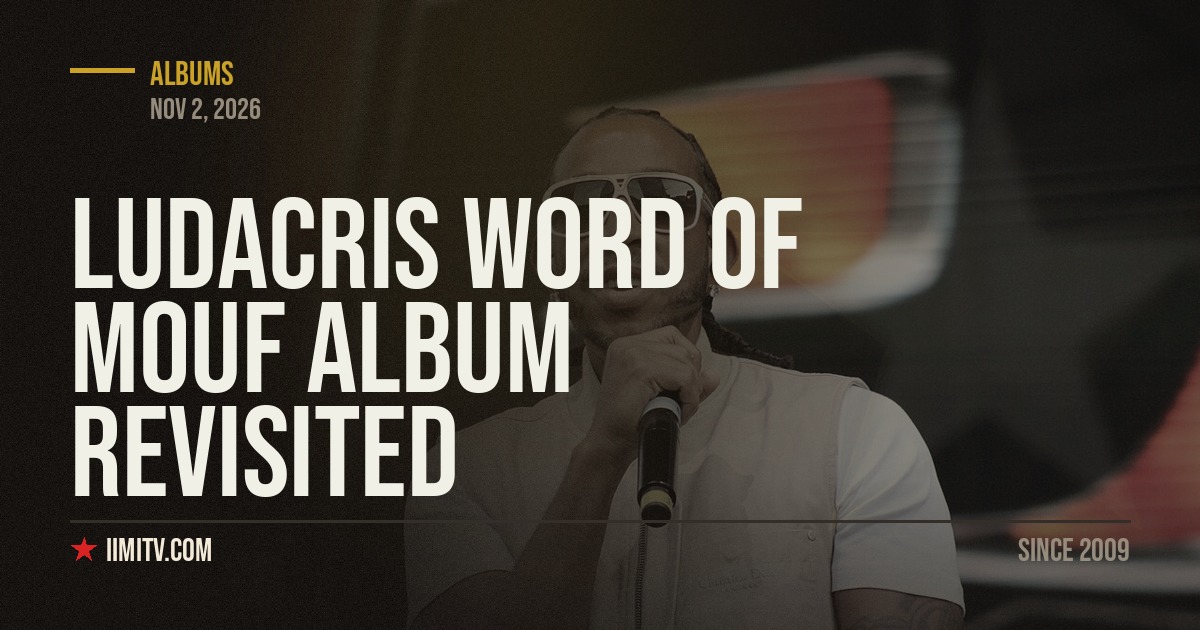
Ludacris released Word of Mouf on November 27, 2001, and the album turns 25 later this month. The Word of Mouf album, released through Disturbing tha Peace and Def Jam South, debuted at No. 3 on the Billboard 200 with 281,000 copies sold in its first week, earned triple platinum certification from the RIAA, and was nominated for Best Rap Album at the Grammy Awards.
This is a revisited piece, not new news. Word of Mouf is a catalogue album, and its anniversary is the honest frame. What it offers in 2026 is a clear look at the moment Southern hip hop stopped asking for a seat in the mainstream and started setting the table. Ludacris, born Chris Bridges and raised on Atlanta radio as Chris Lova Lova, had already scored with Back for the First Time. Word of Mouf was the bigger swing, 78 minutes of comedy, menace and technical rapping sequenced for the CD era.
Word of Mouf album: the singles run
Four singles carried the album across a full year. Area Codes, featuring Nate Dogg, arrived first in July 2001 from the Rush Hour 2 soundtrack and gave Ludacris a coast-to-coast record built on a telephone joke turned national hook. Rollout (My Business), produced by Timbaland and released in October 2001, reached the Top 20 of the Billboard Hot 100 and earned Ludacris a Grammy nomination for Best Male Rap Solo Performance. Saturday (Oooh! Ooooh!), featuring Sleepy Brown, peaked at No. 22 in early 2002. Move Bitch, featuring Mystikal and I-20, peaked at No. 10 and became the album’s most quoted record.
The range is the story. Area Codes is smooth, Rollout is futuristic and funny, Saturday is a weekend record with Organized Noize soul in its bones, and Move Bitch is pure confrontation. One album holding all four, without sounding scattered, is why Word of Mouf outlasted the novelty tag that critics tried to pin on Ludacris in 2001.
The album underneath the hits
The guest list maps Atlanta and the wider South at the turn of the decade: Mystikal, Nate Dogg, Sleepy Brown, Jagged Edge, Jazze Pha, Shawnna, Three 6 Mafia and I-20, from Ludacris’s own Disturbing tha Peace camp. Production came from a bench that included Timbaland and Organized Noize, with contributions that gave the record both club weight and live instrumentation underneath the jokes.
Deep cuts reward a full front-to-back listen, which is how the album was built. Coming 2 America sets the stage directly into Rollout, and Growing Pains shows the reflective writer inside the cartoon energy. At 78 minutes, Word of Mouf is a CD-era maximalist record, and its sequencing assumes a listener who stays. Streaming habits cut against that now, which is exactly why an anniversary listen in full is the right way back in.
Why Word of Mouf still matters at 25
The album’s commercial record is settled: a No. 3 debut, triple platinum sales, a Grammy nomination for Best Rap Album at the 45th Grammy Awards in February 2003, where it lost to The Eminem Show. Its influence is the larger point. Word of Mouf proved a Southern rapper could be a technical lyricist, a comedy writer and a pop presence in the same verse, and it arrived two years before Atlanta’s takeover of the charts became the industry’s default setting.
The videos did half the cultural work, and they still hold up as documents of the era’s ambition. Director Dave Meyers shot the visuals for Rollout and Area Codes, and the Rollout video, with Ludacris rapping through scenes with an oversized, bobble-head version of himself, became one of the most replayed clips of 2001 and 2002. Saturday (Oooh! Ooooh!) carried the same cartoon scale. In the last great years of the big-budget rap video, Ludacris and Meyers treated comedy as a visual signature rather than a compromise, and Word of Mouf is unthinkable without those images.
There is context in where Ludacris came from, too. Before the Def Jam South run, Chris Bridges was Chris Lova Lova on Atlanta radio, and he released Incognegro independently before Back for the First Time took him national. Word of Mouf is counted as his third studio album on that full timeline, and his second for Def Jam South. Either way it is the record where the radio insider, the independent hustler and the major label star became the same person on tape, at full volume, for 78 minutes.
On November 27, Word of Mouf turns 25. Play it in order, start to finish, the way it was sequenced in 2001. The singles explain the fame. The full album explains the staying power.