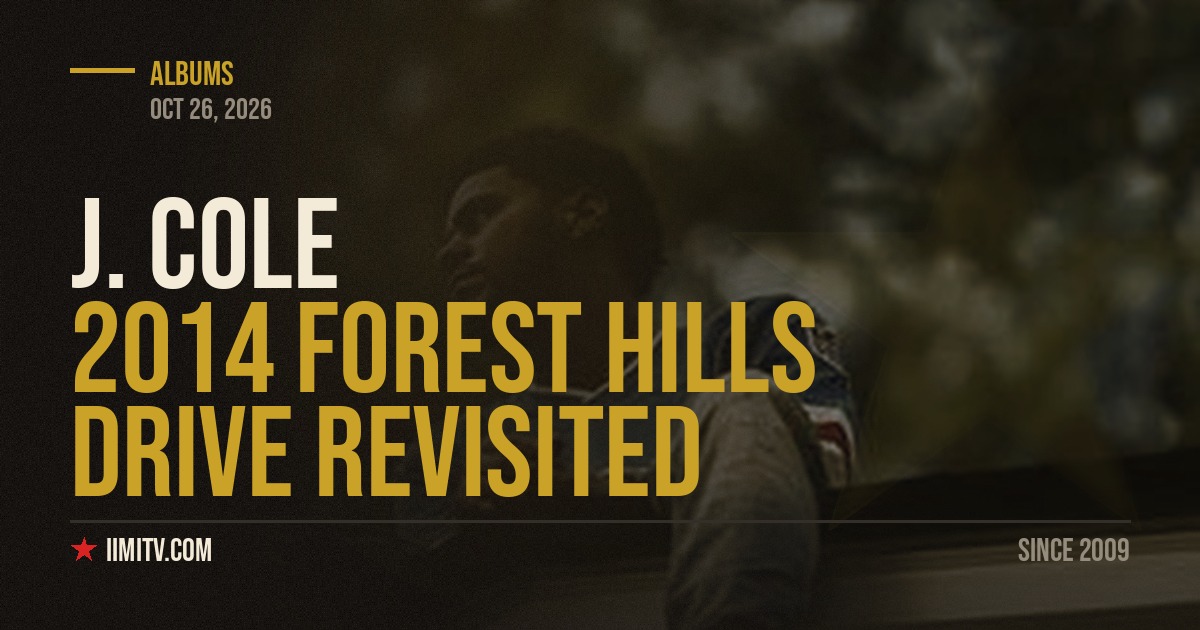
J. Cole released 2014 Forest Hills Drive on December 9, 2014, with no lead single, no guest features and almost no promotion. Nearly twelve years later, the album he named after his childhood home in Fayetteville, North Carolina stands as the centre of his catalogue, the record that turned going platinum with no features from a running joke into a career thesis.
A Quiet Rollout for 2014 Forest Hills Drive
Cole announced the album on November 16, 2014, barely three weeks before it arrived, with a short film instead of a single. The title is an address: 2014 Forest Hills Drive was the house he grew up in, the one his family lost during his childhood and the one he bought back once his career allowed it. The cover puts him on its roof, sitting over the street that raised him, and the thirteen songs inside work like a walk through the rooms: ambition, guilt, first love, and the suspicion that the Hollywood waiting on the other side of success is not worth much.
“I’ve gotten to this point in my career and realized that, yeah, I got a lot more dreams and I wanna go further, but at the same time I don’t want it if it’s at the expense of my happiness.”
That tension is the album’s engine. Cole had already gone gold and platinum as Jay-Z’s Roc Nation signing, with Cole World: The Sideline Story in 2011 and Born Sinner in 2013, the album he famously released on the same day as Kanye West’s Yeezus and outsold within weeks. But Forest Hills Drive is where he stopped chasing the moment and wrote his permanent record instead, producing most of it himself and leaving the feature slots empty on purpose.
Number One, Then a Slow Takeover
The numbers arrived fast and then refused to leave. 2014 Forest Hills Drive debuted at number one on the Billboard 200 with 353,000 copies sold in its first week, 371,000 album-equivalent units under the streaming-inclusive method Billboard had introduced that same month. It was the biggest opening of Cole’s career at the time, earned with no single serviced to radio in advance.
By March 2015 the album was certified platinum, and it became the first rap album in twenty-five years to reach platinum in the United States with no guest appearances at all. It has since been certified triple platinum by the RIAA. The industry noticed in real time: the album won Top Rap Album at the 2015 Billboard Music Awards and Album of the Year at the 2015 BET Hip Hop Awards, and it was nominated for Best Rap Album at the 58th Grammy Awards, where the single “Apparently” also picked up a Best Rap Performance nomination.
The songs kept compounding long after the cycle ended. “No Role Modelz,” the album’s third track, peaked at only number 36 on the Hot 100 yet was certified fourteen times platinum in December 2024, one of the very few diamond-level songs in history to do it without an official music video. “Wet Dreamz” reached nine times platinum in the same round of certifications. The album did not spike; it settled in.
The Songs That Never Left
The tracklist reads like a memoir told in order. “January 28th,” named for Cole’s birthday, opens with the confidence of a rapper who believes the throne is a matter of time. “03′ Adolescence” looks back at the friend who had everything Cole wanted and understood none of it. “Wet Dreamz” turns a first-love story into the album’s warmest three minutes, and its official video, all school corridors and nerves, became the visual most fans attach to the record.

Then there is “No Role Modelz,” the song that outgrew the album entirely. Our breakdown of the ‘No Role Modelz’ lyrics and meaning digs into how a song about father figures and reality television became the most quoted Cole record of all. The album closes with “Love Yourz,” a piano-led argument that no fortune out-earns a life you actually like, performed to this day like a benediction at his shows.
Why 2014 Forest Hills Drive Endures
Catalogue albums usually get one anniversary wave and fade. Forest Hills Drive got a second life: in December 2024, Cole marked ten years with an anniversary edition carrying eight bonus tracks cut from the original double-album sessions, and played the record at a sold-out Madison Square Garden show days later. The songs remain fixtures of his setlists alongside “Middle Child” and the mixtape cuts, which tells you where they sit in the catalogue’s internal ranking.
Sit it between Born Sinner and 4 Your Eyez Only and its role is clear. It is the hinge of the whole discography: the commercial peak that bought him complete creative freedom, and the personal statement everything since has been measured against. Rap has had bigger albums since 2014. It has not had many that aged this quietly well, with no features, no gimmicks and no expiration date.