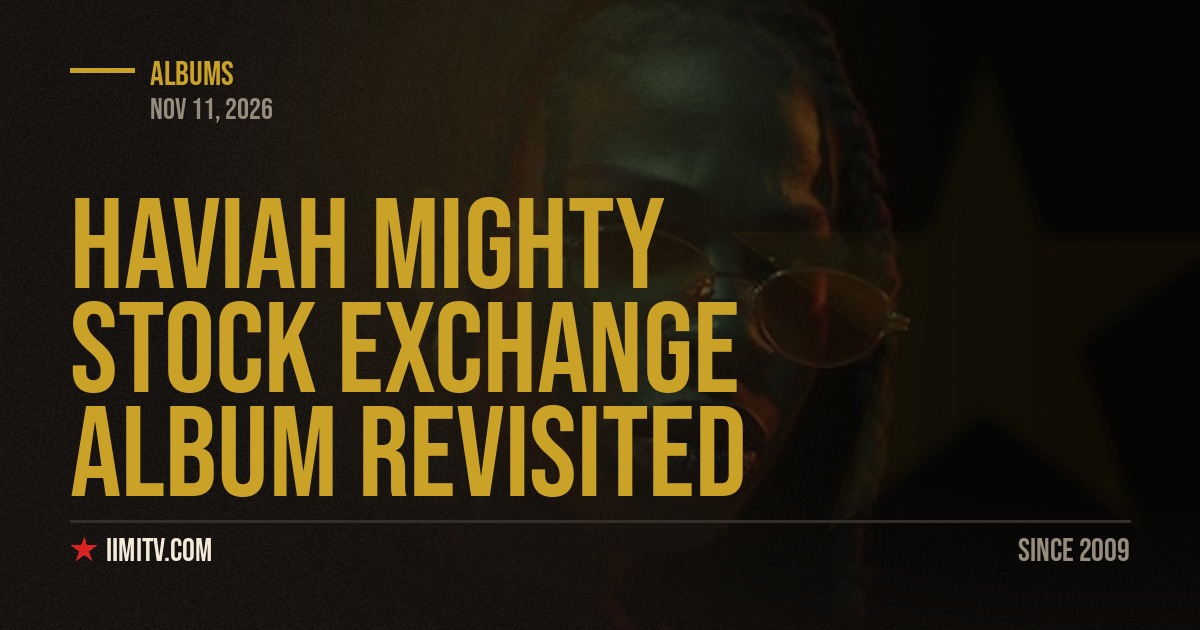
Haviah Mighty released her mixtape Stock Exchange on November 12, 2021. This is a catalogue project, framed as catalogue: nothing here is new, and the record still matters because it is the project that turned a Polaris Prize breakthrough into a sustained run, and the one that made her the first woman ever to win a Juno Award in a rap album category.
The official video for “Obeah,” embedded below, is the mixtape in miniature: a family affair produced with her brother, built on a recording of her father, and rooted in her Caribbean heritage. It sits at track four of twelve, and nothing else in her catalogue sounds quite like it.
Join The iimiTV Letter
Enter your email and we will send you a confirmation link. Click it and your first edition lands on Friday.

Twelve Tracks, Rolled Out For A Year
The mixtape runs 12 tracks, as its release tracklist shows: “Atlantic,” “Occasion,” “Antisocial” featuring Old Man Saxon, “Obeah,” “Good On My Own Tonight” featuring TOBi, “Way Too Fast” featuring Jalen Santoy, “Protest” featuring Yizzy, “Avocado,” “Flamenco” featuring Mala Rodríguez, “Tesla,” “Coulda Been U” featuring Astrokidjay and “So So” featuring Dai Burger. The guest list is the point: a Latin Grammy winner from Barcelona, a London grime MC, American rappers, and Toronto names including TOBi, Astrokidjay and producer Grandtheft, all on one independent Toronto project.
The rollout itself took a full year, as the release coverage recorded: the mixtape arrived exactly one year after its first single, “Atlantic,” and its songs were previewed one by one through the pandemic year, including “Protest,” “Obeah” and “Tesla.” That slow build is why Stock Exchange reads less like a stopgap between albums and more like a second debut, a month by month argument that the 13th Floor win, revisited in our return to 13th Floor, was a beginning and not a peak.
A Title About What An Artist Is Worth
The title is a reckoning, and Mighty named it herself at release. Stock Exchange refers, in the project’s own release framing, to the internal reckoning she went through over how artists are now forced to validate their value as creators from a set of data metrics, follower counts, views and streams, and what that measuring costs the human experience of art itself. The songs keep returning to that ledger from different sides: the roots of capitalism on “Atlantic,” systemic racism on “Protest,” independence on “Antisocial” and “Good On My Own Tonight,” and success contemplated, not just celebrated, on “Tesla.”
Her “Tesla” release notes put the balance plainly: the song looks at travel as a marker of how far she has already come, a moment of reflection inside forward momentum, co-produced with Young Dreadz and carried by a video game inspired visual directed by Jesse Bryan. Heard inside the full tracklist, “Tesla” is the mixtape’s thesis at cruising speed, while “Protest,” her Toronto meets London drill record with Yizzy, is the thesis at full volume, a defiant outcry against anti-Black racism that Rolling Stone praised for keeping the spirit of the 2020 demonstrations alive.
Obeah, The Family Record At Its Centre
“Obeah” carries the deepest roots on the project, as her own song explanation lays out. The title references the Caribbean and West African practice she describes as applying occult powers or higher knowledge, and the song was bred, in her words, out of a conversation with her father, an 11 minute recording of him talking about Obeah as it relates to friendships, progress and the potential dangers of others. Her brother Mighty Prynce produced the track, her father appears in its bridge and its video, and Mighty centred the whole record on trust, spirituality and the energies a person allows around them in order to prosper.
That is the house detail this desk keeps coming back to on Stock Exchange: for all its international guests and industry talk, the mixtape’s centre of gravity is a Toronto family, a father sampled, a brother producing, a daughter turning a kitchen table conversation into the darkest and strongest song on the record. The global reach was earned outward from a very local root.
The Juno That Made History Again
The award chapter is stated plainly in her later release history: Stock Exchange won the 2022 Juno Award for Rap Album or EP of the Year, the first time a woman had ever won in a rap album category. It was her second Canadian first in three years, after 13th Floor made her the first hip hop artist and first Black woman to win the Polaris Music Prize in 2019, and it set up Crying Crystals, revisited in our return to Crying Crystals, the inward turning album that followed in 2023.
Released on November 12, 2021, Stock Exchange remains the bridge record of Haviah Mighty’s catalogue: twelve tracks rolled out over a year, an international guest list anchored by a family record at its centre, and a title that still asks the sharpest question in her work, what an artist is worth when the numbers are taken away.