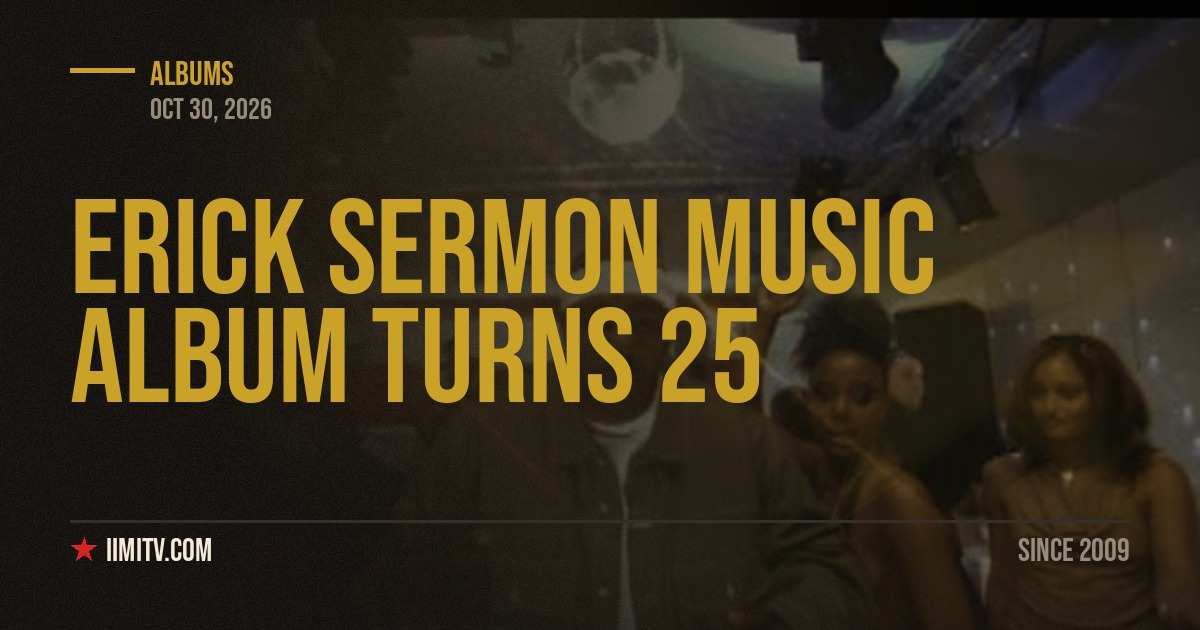
Erick Sermon’s fourth solo album Music turns 25 today. It was released on October 30, 2001, through J Records, and the Erick Sermon Music album remains the commercial and creative peak of his solo career.
This is an anniversary, not a new release, and the date is exact: twenty five years ago today, the Green Eyed Bandit stepped out from the EPMD catalogue he had built with PMD and DJ Scratch and delivered a major label solo album organized around one extraordinary idea, building modern boom bap around the unreleased voice of Marvin Gaye.
The Marvin Gaye Tapes Changed Everything
The turning point came when Sermon secured rare archival studio tapes of unreleased Marvin Gaye vocals, recorded in Ostend, Belgium during the sessions for “Turn On Some Music,” shortly before Gaye’s death. Rather than treating the vocal as a short loop, Sermon arranged a full sun drenched funk production around it. The title track, “Music,” first debuted on the soundtrack of the film What’s the Worst That Could Happen? before exploding as a single.
The numbers still hold up. “Music” reached number 22 on the Billboard Hot 100, number two on the Hot R&B/Hip-Hop Songs chart and number four on Hot Rap Songs, and it earned a Grammy nomination. Behind the scenes, the price of the voice was real. As Sermon later told POW Magazine:
I had to pay like $200,000 to get those Marvin Gaye vocals, but it was worth every penny.

A Fresh Chapter On J Records
The album marked Sermon’s major label solo debut on J Records, the imprint founded by Clive Davis, who personally invited him in. By Sermon’s own account, the success of “Music” converted into a multi million dollar J Records deal, a remarkable second act for an artist whose group work with EPMD, including Strictly Business, Unfinished Business, Business As Usual and Business Never Personal, had already defined East Coast hip hop once.
Music entered the Billboard 200 at number 33 and climbed to number eight on the Top R&B/Hip-Hop Albums chart. It went on to earn Gold certification from the RIAA, and it set up his 2002 follow up. For a producer first artist in his thirties, in a genre that was busy reinventing itself for a new century, it was proof that the EPMD sound could still top charts on its own terms.
Range Across The Tracklist
The album is remembered for its title track, but its range is the argument for revisiting the whole thing. On “Ain’t No Future…2001,” Sermon pays homage to MC Breed’s 1991 classic and shows his production adapting West Coast G-funk sensibilities with ease. Across the record, vintage soul archives and classic P-Funk fundamentals are integrated into boom bap without sanding off the street level detail that made his name.
That integration was always Sermon’s gift. As a producer he built EPMD’s sound on thick funk samples long before it was the default language of East Coast rap, and Music is where the method met its most emotional source material. A posthumous duet is a risky form; handled badly, it feels like a gimmick. Handled the way Sermon handled it, with the Gaye vocal treated as a lead performance rather than a sample, it felt like a conversation across generations.
Why Music Still Matters At 25
Twenty five years on, Music endures as a masterclass in sample based production and as the bridge between Motown soul and East Coast hip hop that its title promised. The official video became an MTV staple, the single still anchors early 2000s rap playlists, and the album’s method, find the feeling in the archive and build the record around it, has become standard practice for producer led albums ever since.
The anniversary has also been marked in hip hop media this week, with retrospectives tracing the album from the soundtrack placement to the J Records signing in one line. That line is the cleanest summary of what Music did: a single built from a fifteen second vocal fragment, cut in a burst of inspiration, became the engine of an entire album, a label deal and a second commercial peak.
Sermon remains active as a producer and curator, including his Dynamic Duos work pairing classic voices over his production. But the solo peak is this one. If you have never played Music front to back, the anniversary is the excuse: start with the title track, stay for the funk, and hear a producer at the exact moment his past and his future shook hands.