Clipse released Let God Sort Em Out on July 11, 2025, their first album in sixteen years and the closing chapter of one of the strangest catalogue arcs in rap. Read against Lord Willin’ and Hell Hath No Fury, the reunion is less a comeback than a final exam the Virginia Beach duo set for itself, and passed.
Lord Willin’ and the Neptunes Blueprint
Clipse are brothers, Gene “Malice” Thornton and Terrence “Pusha T” Thornton, from Virginia Beach, Virginia. They met Pharrell Williams and Chad Hugo as teenagers, and the production duo who became the Neptunes convinced the brothers to work as a pair. Their first album, Exclusive Audio Footage, was shelved by Elektra in 1999, a false start that cost them three years. The real debut, Lord Willin’, landed on August 20, 2002 on the Neptunes’ Star Trak label, opened at number four on the Billboard 200 and number one on the Top R&B/Hip-Hop Albums chart with 122,000 copies in its first week, and was certified gold within two months.
“Grindin’,” built from little more than a knock, a snap and menace, became the sound of that summer and one of the defining singles of the decade. The follow-up, 2006’s Hell Hath No Fury, arrived late after a long label dispute and landed like a critic’s argument made flesh: thirteen tracks, produced entirely by the Neptunes, cold and precise, and routinely placed among the finest rap albums of the 2000s. Pusha T still calls it his favourite Clipse album. Til the Casket Drops followed in December 2009, and then the story appeared to end.
The Split, and the Long Way Back
The breakup was Malice’s call. As the duo’s world closed in at the end of the 2000s, with people around them facing arrest, he walked away from the group, converted to Christianity and renamed himself No Malice, publishing a memoir and two faith-driven solo albums. Pusha T built a solo career inside Kanye West’s GOOD Music camp, from My Name Is My Name in 2013 to the acclaimed Daytona in 2018 and It’s Almost Dry in 2022. For a decade, a reunion looked impossible, and Malice said so himself more than once.
“My dad was instrumental in my decision-making. I asked him what he thought about me rapping again, and he said, ‘You still have to make a living. You still have to take care of your family.'”
The door reopened in stages: a joint appearance as Clipse on Kanye West’s “Use This Gospel” in 2019, a verse together on Nigo’s “Punch Bowl” in 2022, and Malice beside his brother on “I Pray for You” the same year. By 2023 they were recording again, quietly, and this time the subject matter had changed. The brothers had lost both of their parents in the years between albums, and grief, faith and survival run through everything that followed.
Let God Sort Em Out, the Independent Album
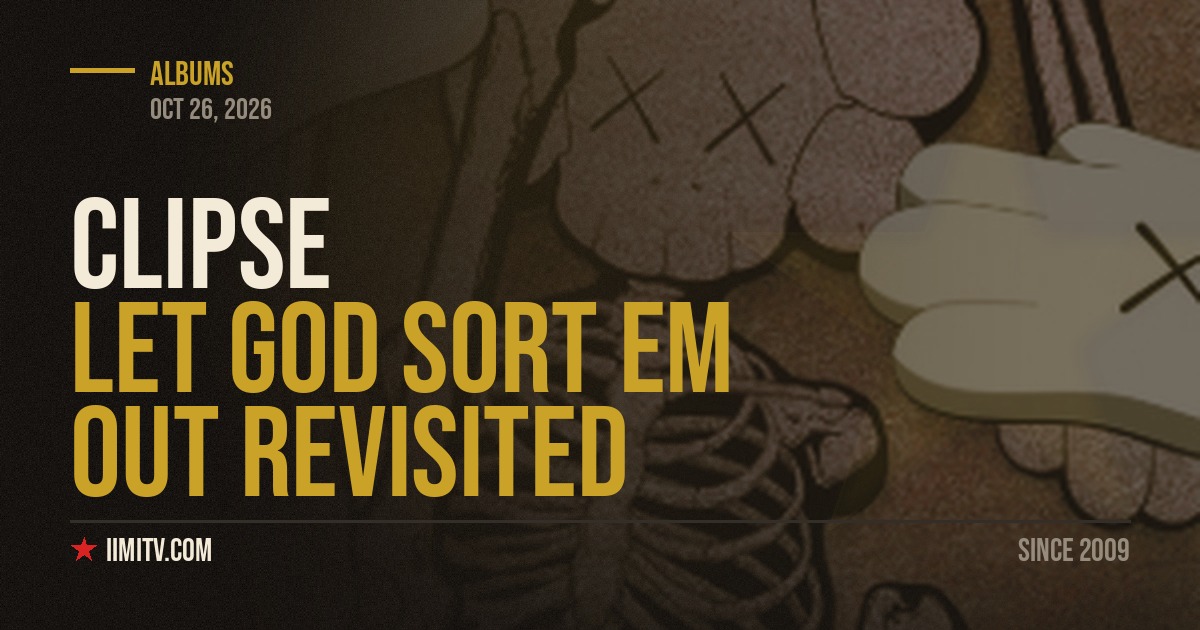
The reunion album was made largely where the story started and somewhere nobody expected: Virginia Beach studios, and the Louis Vuitton headquarters in Paris, where Pharrell Williams, the duo’s mentor since their teens and now the house’s men’s creative director, produced the entire record alone. It is the first Clipse album carried by Williams without the Neptunes name, thirteen tracks in forty-one minutes, with cover art by KAWS and guests including Kendrick Lamar, Tyler, The Creator, Nas, John Legend and the Voices of Fire choir.
Clipse left their Def Jam deal to release it on their own terms, self-releasing through Roc Nation Distribution on July 11, 2025. The independence showed in the numbers: Let God Sort Em Out debuted at number four on the Billboard 200 with 118,000 units, 58,000 of them pure album sales, and at number one on the Independent Albums chart, matching the chart peak of Lord Willin’ twenty-three years earlier while belonging entirely to them. A first American tour in nearly two decades followed that autumn.

A Grammy at the End of the Road
The industry finished the sentence in February 2026. Let God Sort Em Out was nominated for Best Rap Album at the Grammy Awards, and “Chains & Whips,” the album’s Kendrick Lamar collaboration, won Best Rap Performance, the first Grammy of the brothers’ thirty-year career. Clipse performed at the ceremony with Williams, a full-circle image: the Virginia Beach kids and their producer, three decades on, collecting the award the shelved debut and the label disputes once made unthinkable.
That is why this catalogue reads differently from most reunion stories. Lord Willin’ made Clipse stars, Hell Hath No Fury made them a critical standard, and the sixteen-year silence made a third act feel impossible. Let God Sort Em Out closed the loop without nostalgia doing the work: new grief, new faith, the same surgical writing, released independently and decorated at the highest level. Few catalogues in rap are this short, this consistent, or this completely finished. More from the catalogue desk lives in our Revisited archive.