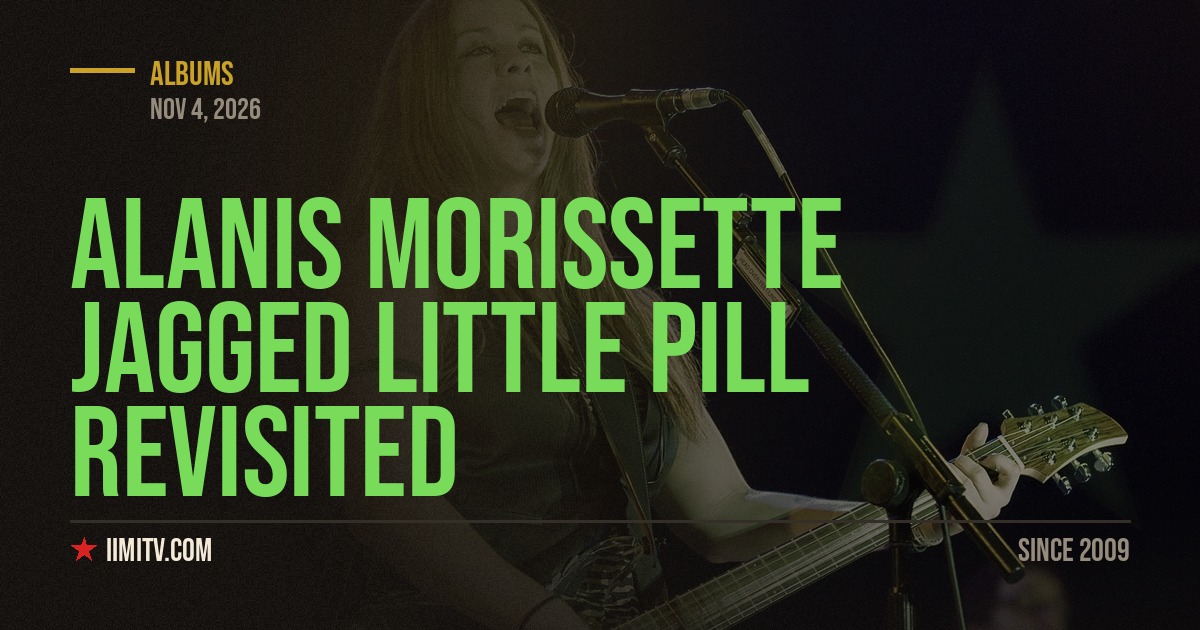
Alanis Morissette released Jagged Little Pill on June 13, 1995, through Maverick and Reprise, and the record became the centre of her career. The Jagged Little Pill album, her third studio release and her first issued worldwide, has sold more than 33 million copies, topped charts in thirteen countries, and made the Ottawa singer the first Canadian artist to reach double diamond certification at home.
That is the honest frame for this deep dive. Nothing about the album is new, and that is the point. Three decades on, it remains the commercial high water mark for a Canadian artist working in rock and pop songwriting, a record whose singles still anchor radio, whose awards haul still reads as unlikely, and whose path to release explains how different the music business worked in 1995. Canadian catalogue pieces rarely get bigger raw material than this.
Join The iimiTV Letter
Enter your email and we will send you a confirmation link. Click it and your first edition lands on Friday.
Two Canadian pop albums came before the Jagged Little Pill album
Morissette was not a debut artist when the album arrived. She had released two dance pop records in Canada, Alanis in 1991 and Now Is the Time in 1992, both aimed at a domestic teen pop market and neither issued internationally. When that chapter stalled, she relocated to Los Angeles and began writing with producer Glen Ballard, a veteran songwriter who had worked with Michael Jackson and Paula Abdul. The sessions moved quickly and informally, with the pair writing and demoing songs at Ballard’s studio pace, and the album was recorded at Westlake in Hollywood with Ballard producing.
The change in setting changed the writing. The Canadian pop records had been built around other people’s expectations. The Ballard sessions were built around Morissette’s own voice, in every sense: the lyrics drew directly on her relationships, her anger, and her humour, and the arrangements left room for a singer who attacked lines rather than smoothing them out. Maverick, Madonna’s label, took the record, and Reprise handled it as her worldwide introduction in June 1995.
Six singles carried Jagged Little Pill across 1995 and 1996
The rollout was a slow build rather than an instant coronation. The album debuted at No. 117 on the Billboard 200 and climbed for months before reaching No. 1 in October 1995, where it stayed for twelve weeks. Six singles did the carrying. You Oughta Know, the furious first single, featured Flea on bass and Dave Navarro on guitar and won two Grammy Awards on its own. All I Really Want and Hand in My Pocket kept the record on radio through the fall.
Ironic, released in 1996, became the signature song: a list of situations debated ever since for whether they are truly ironic, carried by a video that put four versions of Morissette in one car on a winter drive. You Learn and Head Over Feet followed, and Head Over Feet spent eight weeks at No. 1 on the Billboard adult pop chart. Read together, the six singles show the album’s range, from the confrontation of You Oughta Know to the gratitude of You Learn, and they explain why the record kept selling long after a normal album cycle would have cooled.
The numbers behind Jagged Little Pill still stand apart
The commercial record is well documented. Jagged Little Pill was the best selling album worldwide in 1996, moving 18.7 million copies in that year alone. It has been certified seventeen times platinum by the RIAA in the United States and ten times platinum in the United Kingdom. In Canada, Music Canada certified it double diamond, representing two million units, and Morissette was the first Canadian artist to achieve that mark. It was also the first album of the SoundScan era to pass both twelve million and thirteen million in United States sales.
Context matters for those numbers. This was a CD era peak, when a hit album sold physically, week after week, at full price. A Canadian singer with no international profile before June 1995 outsold nearly everyone on earth the following year, and the album did it on the strength of songs she co-wrote, not on features, franchise tie-ins, or a pre-built global fanbase. For Canadian artists measuring what is possible from a standing start, the Jagged Little Pill album remains the reference point.
Grammys, Junos and a Broadway second life
The awards followed the sales. At the 1996 Grammy Awards, the album received nine nominations and won five, including Album of the Year and Best Rock Album, plus Best Female Rock Vocal Performance and Best Rock Song for You Oughta Know. At twenty one, Morissette was the youngest artist ever to win Album of the Year, a record she held for fourteen years. At the 1996 Juno Awards in Canada she won six trophies, including Album of the Year, Single of the Year for You Oughta Know, Female Vocalist of the Year, Songwriter of the Year, and Best Rock Album. Ironic then earned two more Grammy nominations in 1997, including Record of the Year.
The album’s afterlife has kept extending. Rolling Stone placed it on its 500 Greatest Albums of All Time list, the Rock and Roll Hall of Fame included it among its definitive albums, and in 2019 the record became a Broadway musical, with a book by Diablo Cody, that went on to win two Tony Awards. Few catalogue albums get a second life that varied: a radio staple, a sales landmark, a feminist songwriting landmark argued over in classrooms, and a stage production.
Revisited honestly, Jagged Little Pill is not a nostalgia item. It is the biggest album a Canadian artist has ever taken around the world, built by a twenty one year old from Ottawa who had already been dropped into two careers before the one that counted. The songs hold up because the writing was specific, and the numbers hold up because the world bought the specificity. That combination is why this record still anchors any serious account of Canadian music.