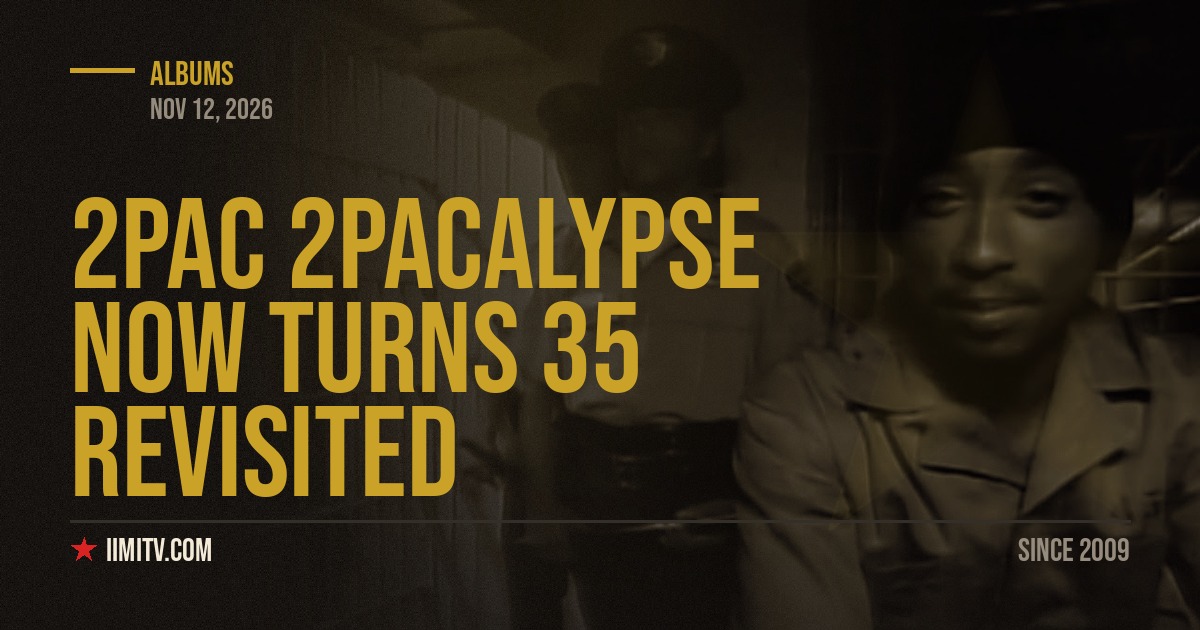
2Pac released his debut solo studio album 2Pacalypse Now on November 12, 1991, through TNT and Interscope Records, and the album turns 35 today. This 2Pacalypse Now album revisited look starts with the original release date stated plainly: Tuesday, November 12, 1991, a 13 track, 55 minute record made while he was still a member of Digital Underground’s orbit, recorded in Richmond, California, with the group’s production team, the Underground Railroad, behind the boards.
The title itself announced the intent, a play on Francis Ford Coppola’s 1979 film Apocalypse Now, and the album’s reference page carries the credit list that shaped it: Big D the Impossible, Shock G, Pee-Wee, DJ J-Z, Raw Fusion and Live Squad produced, with Atron Gregory as executive producer. Contributions came from Stretch, Angelique, Dave Hollister, Pogo, Poppi, Ray Luv and Shock G. Shakur had been introduced to most listeners earlier that year on Digital Underground’s Same Song; the debut album was where he spoke alone, at length, for the first time.
Join The iimiTV Letter
Enter your email and we will send you a confirmation link. Click it and your first edition lands on Friday.
2Pacalypse Now By The Numbers
The first chart run was modest, and the record’s reputation did the rest. In the United States the album peaked at No. 64 on the Billboard 200, No. 13 on Top R&B/Hip-Hop Albums and No. 3 on both the Heatseekers Albums and Top Catalog Albums charts. On April 19, 1995, the Recording Industry Association of America certified it Gold for sales of 500,000 or more copies, a mark reached three and a half years after release, on the strength of the catalogue rather than a radio single. Its biggest single, Brenda’s Got a Baby, reached No. 3 on the Hot Rap Songs chart, and the album has kept selling across every format revival since, including a No. 21 peak on the Vinyl Albums chart in 2016. It also finished 1992 at No. 39 on the year end Top R&B/Hip-Hop Albums chart and reached No. 35 on the UK R&B Albums chart in 1997, evidence the record kept finding new listeners in new markets long after its first run had ended.
Thirteen Tracks, One Production Family
The sequence runs Young Black Male, Trapped, Soulja’s Story, I Don’t Give a Fuck, Violent, Words of Wisdom, Something Wicked, Crooked Ass Nigga, If My Homie Calls, Brenda’s Got a Baby, Tha Lunatic, Rebel of the Underground and Part Time Mutha. Read as a table of contents, it is the blueprint of everything that followed: police pressure, poverty, teenage pregnancy and racism handled in direct language, with storytelling doing the work that hooks did elsewhere. Trapped, the lead single released September 25, 1991, got a video directed by Allen and Albert Hughes, filmed on August 11, 1991, with Shock G singing part of the chorus and Shakur performing from a jail cell. Watch it here:

Brenda’s Got a Baby, released October 20, 1991, with Dave Hollister singing, remains the album’s defining piece of writing: a twelve year old mother, told in the third person, without a chorus built for radio. The third single, If My Homie Calls, followed on December 20, 1991. All three singles carried videos, and all three are arguments rather than advertisements. As The Source put it in its anniversary history of the album: “This was not an album for the radio; it was an album for the people.”
Thirty Five Years On
The physical traces of the debut are now museum pieces. Shakur’s handwritten liner notes for 2Pacalypse Now, written in blue ink and listing the songs and production credits in his own hand, are held by MoPOP in Seattle as part of its collection, an artefact of a record that was organised on notebook paper before it was anything else. The career that followed, Strictly 4 My N.I.G.G.A.Z. in 1993 and then the run that made him one of the best selling artists of all time, starts here, and the debut is rawer and more political than the records that made him famous.
Thirty five years after November 12, 1991, the right way into the album is still the order he left it in: Trapped for the pressure, Soulja’s Story for the narrative control, and Brenda’s Got a Baby for the writing that announced a major artist. The chart peak was No. 64. The Gold plaque came in 1995. The influence never needed either number, and this revisited pass closes with the debut where the whole catalogue begins.