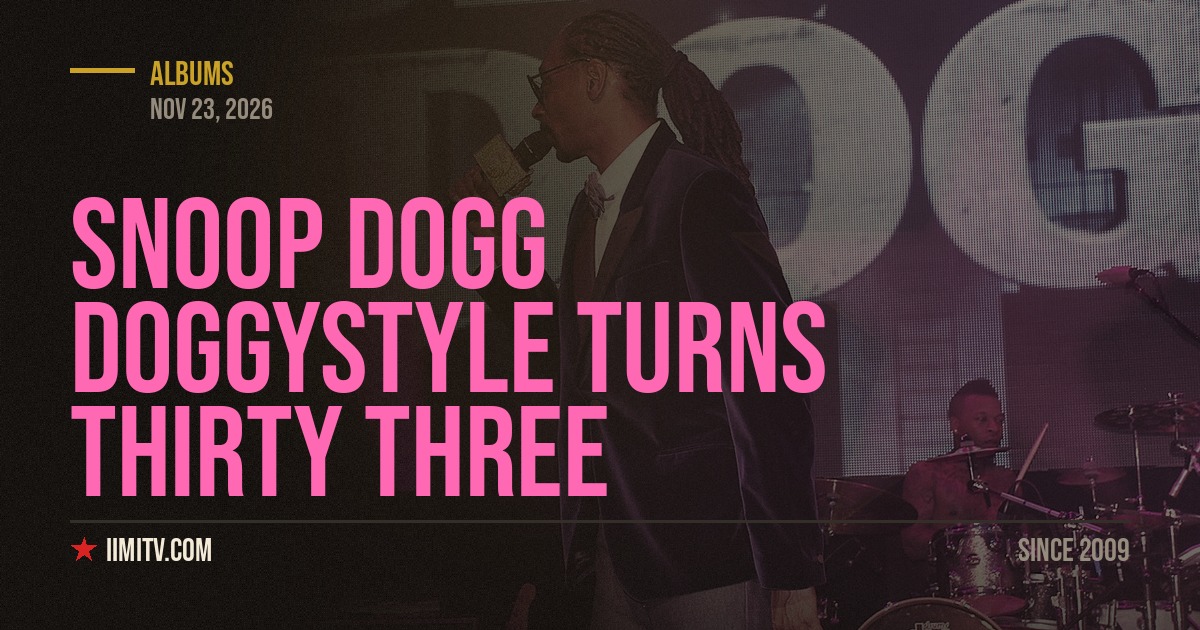
Snoop Dogg released Doggystyle on November 23, 1993, and the Dr. Dre produced debut turns 33 today. The Snoop Dogg Doggystyle album debuted at No. 1 on the Billboard 200, selling 806,858 copies in its first week, a record for a debut artist at the time.
That date matters. This is an anniversary revisit, not a new release, and the album has been in the culture long enough that its first week numbers now read like a different era of the music business, one debut, one producer, and a sound that took over a continent.
Join The iimiTV Letter
Enter your email and we will send you a confirmation link. Click it and your first edition lands on Friday.
The Chronic Opened The Door
Snoop arrived with the rarest kind of runway. His turns on Dr. Dre’s The Chronic in 1992, and on Dre’s Deep Cover before it, had already made his voice one of the most recognizable new sounds in rap before he had an album of his own. The Source, marking the anniversary today, puts it plainly: Snoop had become a full fledged solo superstar on arrival, and Doggystyle solidified the West Coast’s dominance in one of hip hop’s most transformative eras.
Dre built the record on Parliament-Funkadelic inspired grooves, heavy basslines and soulful melodies, and Snoop floated over all of it with a delivery so relaxed it sounded effortless. The Joe Cool illustrated cover, an animated version of Snoop’s canine alter ego, gave the sound a face that record stores could not miss.
The Songs That Never Left
The tracklist still reads like a singles campaign that never ended. Who Am I? (What’s My Name?) established Snoop’s solo identity on a George Clinton inspired funk record. Gin and Juice became a defining anthem of the 1990s. Doggy Dogg World brought in Tha Dogg Pound and The Dramatics, tying the new West Coast sound directly to classic soul, and Lodi Dodi reworked the Slick Rick and Doug E. Fresh standard in a Long Beach accent.
It was also a crew record. Nate Dogg, Kurupt, Warren G, Tha Dogg Pound, The Lady of Rage and RBX all pass through it, which is why Doggystyle plays less like a solo debut and more like the opening statement of the whole Death Row movement.
Doggystyle By The Numbers
The commercial record is the concrete detail that separates this debut from almost every other. The album debuted at No. 1 on the Billboard 200 with 806,858 first week copies, then the fastest selling hip hop album ever and a record for a debuting artist. The RIAA certified it quadruple platinum on May 31, 1994, barely six months after release, and by November 2015 it had sold 7 million copies in the United States and more than 11 million worldwide.
The critics were close, but not unanimous. The Source awarded it 4 mics on release, with reviewer Reginald Dennis suggesting parts of it felt rushed and narrowly missed the magazine’s 5 mic standard. Time settled that argument. Rolling Stone placed Doggystyle at No. 340 on its 500 Greatest Albums of All Time in 2020, and Apple Music ranked it No. 84 on its 100 Best Albums list in 2024.
Why It Still Runs
Thirty three years on, the album’s blueprint is still the template debut artists get measured against: one producer with a defined sound, one voice nobody could mistake, and a crew introduced inside the star’s own record. Snoop and Dre themselves returned to the formula with Missionary in December 2024, a spiritual sequel that only underlined how much of their shared language was set in November 1993.
For Canadian listeners, Doggystyle was part of the G-Funk wave that filled Toronto and Montreal radio through the mid 1990s and shaped what a West Coast record was supposed to sound like for a generation. Anniversaries are easy content. This one is earned: the numbers, the crew and the sound all still hold up.