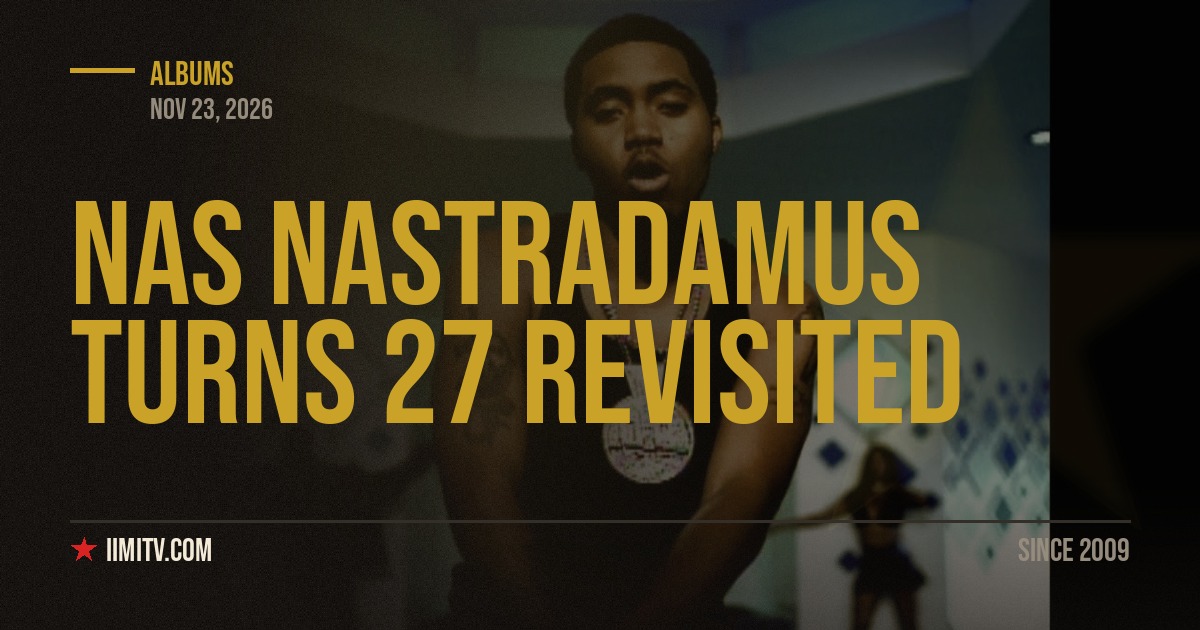
Nas released his fourth studio album Nastradamus on November 23, 1999, through Ill Will and Columbia Records, and its 27th anniversary lands today, Monday, November 23, 2026. This Nas Nastradamus revisit starts with the strangest fact about it: the album was never supposed to exist in this form. It was first planned as a record built entirely from the sessions for I Am…, his third album, and the album’s documented history records what happened next: bootlegging of that material pushed the release from October 26 back a month while Nas went back into the studio and recorded new songs.
The single that survived the rebuild became its biggest record. You Owe Me, featuring Ginuwine and produced by Timbaland, arrived with a David Meyers directed video carrying cameos from Destiny’s Child and DMX. Watch the official video here:
Join The iimiTV Letter
Enter your email and we will send you a confirmation link. Click it and your first edition lands on Friday.

Nastradamus By The Numbers
The commercial record was stronger than the album’s reputation suggests. Nastradamus debuted at No. 7 on the Billboard 200 with more than 232,000 copies sold in its first week and peaked at No. 2 on the Top R&B/Hip-Hop Albums chart, and the RIAA certified it Platinum on December 22, 1999, less than a month after release. Set that against the spring: I Am… had debuted at No. 1 in April 1999 with more than 470,000 first week copies, so Nastradamus was Nas’s second album in seven months, arriving in the busiest release corridor of the decade, one week after Dr. Dre’s 2001 and with Jay-Z’s Vol. 3 waiting in December.
The two singles tell the split story. The title track, released October 26, 1999 and produced by L.E.S. on a sample of the J.B.’s Monaurail, peaked at No. 92 on the Hot 100 and No. 4 on Hot Rap Songs, and its Jeff Byrd directed video was shot in 3D, with Tower Records handing out glasses for its TRL debut. You Owe Me did the heavier commercial work, reaching No. 59 on the Hot 100 and No. 13 on the R&B/Hip-Hop chart, as The Source’s anniversary history notes in calling it one of the project’s most recognizable records.
The Leak That Built The Album
The backstory is the reason this record keeps getting searched. I Am… was conceived as a double album, I Am… The Autobiography, before much of it leaked as MP3s, one of the first times a major label rap project was undone that way. Nas cut replacement material for a single disc I Am…, and Columbia planned to issue the leftover sessions as Nastradamus that fall. At the last minute he chose to record an almost entirely new album instead, on a rushed schedule aimed at the November date, and one survivor made the crossing: Project Windows, featuring Ronald Isley and produced by Nashiem Myrick and Carlos Broady of the Hitmen, widely held now as the album’s finest song.
The production bench shows the rush and the ambition at once. L.E.S. handled five of the 15 tracks and Dame Grease four, DJ Premier contributed Come Get Me, and Havoc, Timbaland and Rich Nice round out the credits across a 63 minute running time. The guest list, Mobb Deep, the Bravehearts, Ginuwine and Ronald Isley, is Queensbridge and its extended family. Reviews split hard on arrival, and Nas himself settled the argument years later, telling Rolling Stone in 2014: “It was a gray area in my life and that album represents that gray area. It was personal stuff that I’d rather not elaborate on. But I have nothing against that album.”
Why Nastradamus Still Matters
What came next gives the album its place. Stillmatic, in December 2001, was received as the comeback, and The Lost Tapes in 2002 finally gave some of the pirated I Am… material an official release, which means Nastradamus stands as the middle panel of a three year story about leaks, deadlines and recovery. On iimiTV, the later end of that arc is covered in Nas King’s Disease III Revisited, and the distance between the rushed 1999 record and the Hit-Boy era is exactly what makes both ends worth reading.
Start with Project Windows for the writing, Come Get Me for the Premier record, You Owe Me for the hit, and Life We Chose for the album’s quiet centre, then judge the whole 15 tracks in order. Twenty seven years after November 23, 1999, Nastradamus is not the Nas album anyone reaches for first, and it was never going to be. It is the one that shows what the MP3 era did to a major album in real time, and its Platinum plaque says the audience stayed through it anyway.