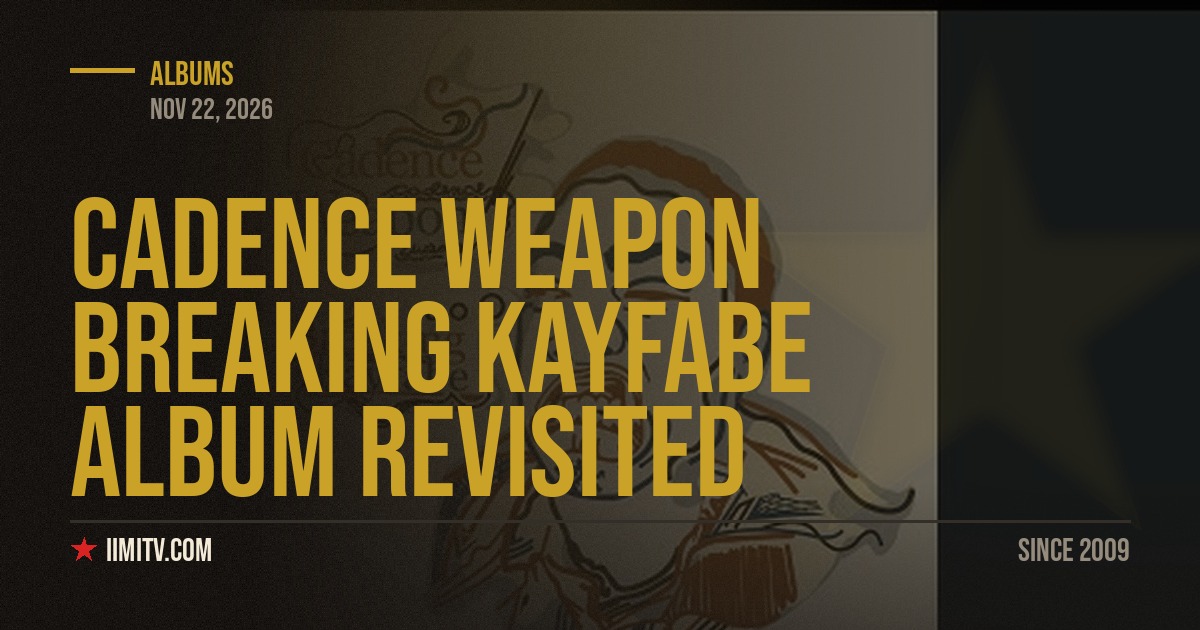
Cadence Weapon released his debut album, Breaking Kayfabe, on November 28, 2005, through Upper Class Recordings. This is a catalogue record, framed as catalogue: 12 tracks, 49 minutes and 40 seconds, produced by Cadence Weapon with Nik Kozub, recorded in Edmonton, and shortlisted for the first Polaris Music Prize the following year. Twenty years on, it still reads as the blueprint for a strain of Canadian hip hop that keeps rippling outward.
The official audio for “Oliver Square,” the opening track, is embedded below from the artist’s Topic channel. The song came first in the story as well: posted by Fluxblog in 2005, it helped bring the Upper Class deal that carried the album.
Join The iimiTV Letter
Enter your email and we will send you a confirmation link. Click it and your first edition lands on Friday.

Twelve Tracks Built In Edmonton
The published tracklist runs “Oliver Square,” “Sharks,” “Grim Fandango,” “Black Hand,” “30 Seconds,” “Diamond Cutter,” “Holy Smoke,” “Fathom,” “Turning on Your Sign,” “Lisa’s Spider,” “Vicarious” and “Julie Will Jump the Broom.” The sessions happened at Zonik Studios and Up in Arms Studios in Edmonton, Alberta, and the production was built entirely in FL Studio and sequenced in Cool Edit Pro, a home software setup that was close to unprecedented in Canadian rap at the time. The title itself is a wrestling term: kayfabe is the staged reality wrestlers protect, and breaking it means stepping out of character in public.
The sound matched the method. Contemporary reviews praised the 8-bit style beats and the intellectual lyrics meshing together, and the record holds an aggregate score of 80 out of 100 on Metacritic. One period review heard a dense, paranoid party of synthetic beats and articulate rhymes, with “Oliver Square” as the gripping introduction and “Grim Fandango” borrowing its menace from a survival horror game. Songs like “Oliver Square” also act as time capsules: the Edmonton mini-mall the opener names is now called Unity Square, the location renamed and the landscape altered, while the song keeps the old name in circulation every time it plays.
A 19-Year-Old Who Worked The Room
Cadence Weapon is Roland “Rollie” Pemberton, born and raised in Edmonton, and he arrived with a writer’s background as much as a rapper’s: he had written hip hop reviews for Stylus Magazine and Pitchfork Media before his own record made him the subject. His self-released mixtape Cadence Weapon Is the Black Hand carried early versions of several Kayfabe tracks, and his blog Razorblade Runner caught label attention, including a Def Jam request to remix Lady Sovereign. On stage in that first winter, Exclaim! watched the 19-year-old jump down into the crowd mid-set, weaving through the room without slowing his flow, and quoted his reason plainly: “I really like to have that one-on-one interaction with the crowd.”
That work rate carried the record across borders. He toured extensively behind it, including three shows at South by Southwest in Austin in 2006, Chart magazine named him one of the 15 Canadian artists to watch in 2006, and Metacritic listed Breaking Kayfabe among the best albums of 2006. The album later reached the United States on ANTI- Records on March 13, 2007, with Big Dada handling Europe, a rare export path for an Edmonton rap debut of that era.
The First Polaris Shortlist
The album was shortlisted for the 2006 Polaris Music Prize, the prize’s inaugural year, and lost to Final Fantasy’s He Poos Clouds. The shortlist placed a teenage Edmonton rapper alongside acts like Broken Social Scene and Metric in the first national conversation the prize ever held, and it started a pattern that defines his catalogue: every Cadence Weapon album since has been Polaris nominated, Hope in Dirt City shortlisted again in 2012, and Parallel World winning the prize outright in 2021. Hold the debut beside the win and the arc is exact: the shortlist at 19 became the trophy 15 years later, with the same restless production logic running through both records.
Amplify’s 20-year retrospective makes the same point from the other side: the record feels less like a relic and more like a blueprint, born from urgency and self-awareness, made by a young producer experimenting with software in a way that was almost unprecedented in Canada. That is the information a release-date listing cannot give a reader: Breaking Kayfabe is not only where Cadence Weapon started, it is the first document of how he has always worked, building beats on a laptop in Edmonton, naming his own streets, and treating the local as material worth exporting. Revisited honestly, as a 2005 catalogue album, it earns its place as the foundation under everything this site has covered from him since.