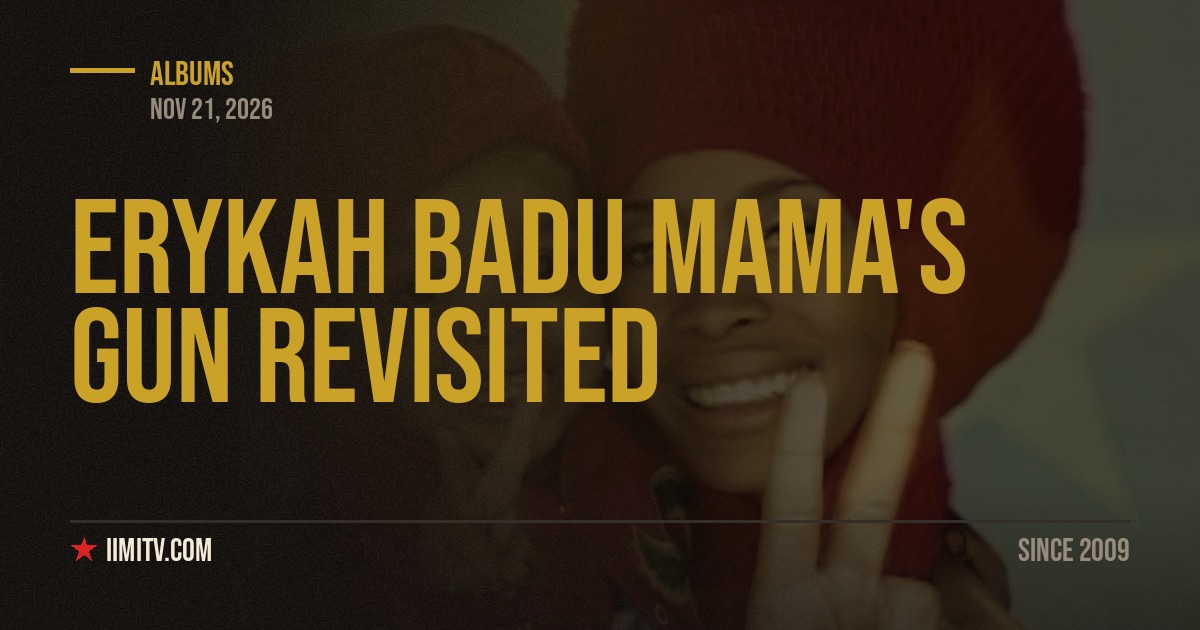
Erykah Badu released her second studio album Mama’s Gun in the United States on November 21, 2000, through Motown, and its 26th anniversary lands today, Saturday, November 21, 2026. This Erykah Badu Mama’s Gun revisit starts at Electric Lady Studios in New York, where the album was largely recorded with the Soulquarians collective, the circle of Questlove, J Dilla, James Poyser and Pino Palladino that was reshaping Black music at the turn of the century. Slant Magazine’s review listing carries the November 21, 2000 release date and the Motown credit, and the record it describes is the fuller, funkier counterpart to her 1997 debut Baduizm.
The album’s lead single still defines it. Bag Lady arrived in August 2000, ahead of the album, and its official video, Badu in red at the centre of the frame, remains the record’s visual signature. Watch it here:
Join The iimiTV Letter
Enter your email and we will send you a confirmation link. Click it and your first edition lands on Friday.

Mama’s Gun By The Numbers
The commercial record was immediate. Mama’s Gun debuted at No. 11 on the Billboard 200 with 191,000 first week copies, the largest opening week of Badu’s career to that point, per the Grammy.com anniversary history, and it peaked at No. 3 on the Top R&B/Hip-Hop Albums chart. The RIAA certified it Platinum about four weeks after release, and it later passed 1.4 million in United States sales, with Gold certifications in Canada, the United Kingdom and the Netherlands alongside. Critics matched the buyers: the album holds a Metacritic score of 80, Rolling Stone named it among its top 10 albums of 2000, and it later placed on that magazine’s 500 Greatest Albums of All Time list.
Bag Lady did the heavy lifting on the singles side. Built on a sample of Dr. Dre’s Xxplosive, itself built on an Isaac Hayes sample, the song reached No. 6 on the Billboard Hot 100, Badu’s first top 10 on that chart, and held No. 1 on the Hot R&B/Hip-Hop Singles and Tracks chart for six consecutive weeks. It earned two Grammy nominations at the 2001 awards, for Best Female R&B Vocal Performance and Best R&B Song, and it reached No. 6 in Canada on the Nielsen SoundScan chart, a genuine Canadian footprint for a record this desk is revisiting from Toronto.
Dilla, The Soulquarians And Didn’t Cha Know
The album’s second single is its production landmark. Didn’t Cha Know, released November 28, 2000, was produced by Jay Dee, the producer the world now knows as J Dilla, and built around Tarika Blue’s Dream Flower. It reached No. 28 on the Hot R&B/Hip-Hop Songs chart and was nominated for Best R&B Song at the 2002 Grammy Awards. Around those two singles, the personnel list reads like a roll call of the era: Questlove on drums, Pino Palladino on bass, James Poyser on keys, Roy Hargrove arranging horns, and Roy Ayers playing vibraphone on Cleva, the album’s third single, released in April 2001.
The 14 tracks run 71 minutes, and the sequencing is the argument. Penitentiary Philosophy opens the record with a Hendrix inspired charge, And On answers her own debut hit On and On, In Love With You is a duet with Stephen Marley recorded at Tuff Gong in Kingston, and Green Eyes closes the album as a three part, ten minute breakup suite that moves through three distinct movements. Badu wrote every song on the record, and the themes the Grammy.com history names, love, self worth and social equity, are carried in the writing rather than in slogans.
Why Mama’s Gun Still Gets Searched
Catalogue interest in this album is not nostalgia alone. Badu toured the record on the Mama’s Gun 25 run, the Return of Automatic Slim tour that opened at the Hollywood Bowl in October 2025, so a new generation of listeners met these songs live a full quarter century after release, and the questions they search afterwards are the ones this album keeps answering: who produced Didn’t Cha Know, what Bag Lady samples, and where the Soulquarians sound came from. The answers all live inside this one tracklist.
Start with Bag Lady for the hit and the sample chain, Didn’t Cha Know for the Dilla production, Cleva for Roy Ayers, and Green Eyes for the closing suite, then play the album in order. Twenty six years after its United States release, Mama’s Gun reads as the moment neo soul’s most distinctive writer took full control of her sound, with the best band of her generation in the room. That is why it holds its place on the greatest albums lists, and why it earns its revisit today.